August Offer came at a time when the British government was at a worse corner as almost all the nations of Europe fell down before the German army. England alone was trying to stand strongly to face the Nazi Army. The Conservatives came to power and Churchill succeeded Chamberlain as the Prime Minister of England and Amery as the Secretary of State for India. At this moment with the deteriorating war situation in Europe forced them to appease India by agreeing to some of their demands. With this compulsion on the British side, the Indian National Congress decided to lay down certain demands along with their accepted support to the government for the war. As a result the Viceroy replied with a statement which came to be known as the August Offer after it was presented on 8th August 1940.
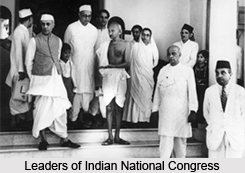 Proposal Made by Indian National Congress
Keeping in mind what the British government wanted, Congress offered to resume co-operation with the British so long as a provisional national government was set up. Both Mahatma Gandhi and Jawaharlal Nehru made statements claiming that India never intended to establish a new nation on the ruin of British crown and accepted that Indian Congress had no intention to support the extreme Nazi regime as against the British paramount. The Congress further stated that it would support the British government to fight the war as it is meaningless to resolve to non-violence when enemy is at the door steps. The Working Committee would extend its help only if the British Government agrees to install a national government in India and makes an announcement regarding the goal of Independence in India after the war. In a reply the Viceroy made the statement claiming that the government will not be in a position to agree to the demands of Congress as it cannot handover the administration of a nation to a party which is unable to provide an all comprehensive body of popular will and has been `directly rejected by the large and powerful elements of India`s national Life`.
The August Offer, as a result, offered three proposals. Firstly, it called for an immediate expansion of Viceroy`s Executive Council with the inclusion of Indian representatives; secondly, an advisory body with the members from British India and Indian princely states which were supposed to meet at consequent intervals was established and thirdly, two practical steps were decided to be taken in which it was to come at an agreement with the Indians on the form which the post representatives body should take and the methods by which it should come to a conclusion. It further planned to draw out the principles and outlines of the Constitution itself.
Reaction of Congress to August Offer
The proposals offered by the August Offer did not satisfy the members of Congress, it was mainly treated as a compromise done by the government to pacify the Indian crowd without much success. The immediate reaction of August proposal was not much alarming except that it clearly mentioned that no claim of congress would be accepted unless it seeks the approval of the minority group which formed a substantial part of Indian population.
Thus, the August Offer was another effort made by the British Government to misguide the Indian leaders who made some effort to convince the government in the favour of independence after the war. This offer only highlighted the minorities who suddenly became very important for the government in decision making.