Ladakh, Jammu & Kashmir - Informative & researched article on Ladakh, Jammu & Kashmir
  Indianetzone: Largest Free Encyclopedia of India with thousand of articles Indian Cities


in  
Art & Culture | Entertainment | Health | Reference | Sports | Society | Travel
Forum  | RSS Feeds  | Free E-magazine
Indian Cities : Ancient Indian Cities l Metropolitan Cities in India l Indian hill stations l Indian Capital Cities l Indian Holy Cities l Port Cities in India l British Cathedrals in India l Indian Cities l Pilgrimages In India l Tourism in India
Home > Travel > Indian Cities > Indian Cities > Cities of Jammu and Kashmir > Ladakh
Ladakh, Jammu & Kashmir
The ultimate destination for the people who crave for the beauty of nature with serenity is Ladakh.
  History of Ladakh   Tourism in Ladakh   Padum
  Demographics of Ladakh   Culture of Ladakh   Education in Ladakh
  Economy of Ladakh   Mountain Passes in Ladakh   Flora and Fauna of Ladakh
  Agriculture of Ladakh   Monasteries in Ladakh   Geography of Ladakh
  Costumes of Ladakh   Religion of Ladakh   Leh District
  Architecture Of Ladakh      

Enveloped in pure white snow, with a view of heaven and mystifying experience realm of Ladakh is the perfect haven for rejuvenating exhausted spirit. Ladakh, a region in Jammu and Kashmir, is renowned for its remote areas and its culture. Further to the west, the land of the Drogpahs (Dards) opens up its doors. These Aryans settlers came from Baltistan and they belonged to the kingdom of Gilgit. Five Dard villages belong to Ladakh and they are the gateway to an amazing world. Ladakh is truly a self-reliant land and this self-sufficiency of Ladakh is based on an economy of small agricultural communities dependent on glacial torrents which, in wild and joyous uproar, come and meet the large Himalayan Rivers.

Location of Ladakh
Ladakh, Jammu & KashmirSituated in the eastern part of Jammu and Kashmir, Ladakh covers about 45000sq miles and is one of the sparsely populated cold desert regions that include the Western Himalayan range, the Karokaram range and the upper Indus river valley. Taking them from south to north, these consist of the Great Himalaya itself, falling to the trough of the Zanskar and Suru valleys; the Zanskar range; the Indus valley, Ladakh`s historical heartland. The Ladakh range, extends into Tibet as the Kailash range, and created more impressive Pang-gong range.

History of Ladakh
The history of Ladakh was first researched and reconstructed by the German scholars. The racial composition of Ladakh`s people exhibits a blending of the Indo-Iranian and the Mongoloid. Ladakh has a great backdrop inhabited with different ethnic groups. It is described as "Little Tibet" or "the last Shangri-La", La-Dags "land of high mountain passes"- and is one of the last enclaves of Mahayana Buddhism. The earliest Tibetans to migrate into Ladakh may have come as nomadic herdspeople, after the fashion of those who still roam the bare upland plateaux of Ladakh, as well as over the border in Tibet. As far as political history is concerned, Ladakh got the recognition as a separate entity after the establishment of the kingdom in about 950 AD. It became a part of independent India in 1948. The religion of Ladakh`s earliest inhabitants was presumably some form of the Bon-chos, more a collection of cults than a unified religion. It is certain that Buddhism first entered the western parts of Ladakh. The Buddhist influence continued to filter in from Kashmir, which was one of its important centres. The first inhabitants of Ladakh are believed to be a combination of nomadic herdsmen from the Tibetan plateau and a small group of early Buddhist from North India known as monks. Further, these two groups got along with the Dards around fifth or sixth century who brought with them the idea of irrigation and farming. The first independent kingdom in Ladakh was established by the Maverick Nobleman Nyima Gon in ninth century, after the collapse of Guge Empire of western Tibet. The state had to face worsened conditions because of the prolonged feuds and assassinations of which the Dogra General Zorawar Singh took benefit and annexed the state and presented it as a gift to the Maharaja of Kashmir in 1834. Then after this, it became a part of independent India in 1948. At present, Ladakh encompasses about 70 percent of Jammu and Kashmir. The Ladakhis saw the establishment of Autonomous Hill Development Council in September, 1995. Local politicians and religious leaders of Leh spent 1990`s blaming the government of intentional mismanagement of (A.H.D.C.) and in 2002 established the Ladakh Union Territory Front which aims at splitting Ladakh from the state of Jammu and Kashmir. The moment of triumph arrived when the newly elected government in Jammu and Kashmir gave power to the (A.H.D.C.) to take internal decisions.

Geography of Ladakh
Ladakh, Jammu & KashmirLadakh is the highest plateau of Jammu and Kashmir state in India with much of it being 3,000 meters (9,800 feet). It includes the Himalayan and the Karokaram mountain ranges and the upper Indus river valley. Before the Partition of India and Pakistan, Baltistan (now under Pakistani administration) was a district in Ladakh. Ladakh`s winter capital was Skardu and summer capital was Leh. Now, its capital is Leh. Ladakh consists of the fairly populous main Indus valley, the more remote Zanskar in the south and Nubra valleys to the north over Khardung La, the almost deserted Aksai Chin and Kargil and Suru Valley areas in the west. Kargil is the second most important town in Ladakh. Before partition, Baltistan remained one of the districts of Ladakh. While Skardu was the winter capital of Ladakh, Leh was considered as the summer capital. The peaks in the Ladakh range are at a medium altitude and are close to the Zoji-la (5,000-5,500 metres, 16,000 - 18,050 ft). They increase towards south-east and reach a climax in the twin summits of Nun-Kun (7000 m, 23,000 ft). The Ladakh range has no major peaks. The average height of the range is a little less than 6,000 metres (19,700 ft), and few of its passes are less than 5,000 metres (16,400 ft). The Pang-gong range runs parallel to the Ladakh range about 100 km northwest from Chushul, along the southern shore of the Pang-gong Lake. Its highest range is 6,700 metres (22,000 ft), and the northern slopes are heavily glaciated. The summer is short lived in Ladakh and the weather remains dry with average temperatures between 10-20 °C (50-70 °F) during the summer. The temperature remains around ?15 °C (5 °F) in winter. Because of lack of vegetation in Ladakh, the proportion of oxygen is less than in many other places at a comparable altitude.

Administration of Ladakh
Ladakh district was a district of the Jammu and Kashmir state of India. In July 1979, it was divided into Leh district and Kargil district. Each of these districts is governed by a Ladakh Autonomous Hill Development Council. This is based on the pattern of the Darjeeling Gorkha Autonomous Hill Council. This council was created as a compromise solution to the demands of Ladakhi people to make Leh a union territory.

Education in Ladakh
The education in Ladakh is based on the system of Indian education and most of the schools of Ladakh are primary schools. In these schools the students are taught Urdu and English with other relevant subjects. As most of the people are engaged in agricultural activities, they tend to involve their successors in the same occupation. As a result the percentage of absence increases in the schools during the agricultural seasons. The Students` Educational and Cultural Movement of Ladakh (SECMOL) launched `Operation New Hope` in 1993. This is a campaign to provide `culturally appropriate and locally relevant education` by a number of means. This programme includes producing Ladakhi textbooks, adopting one language for the teaching of mathematics and science at all ages, and the regular training of teachers. In Leh, a government degree college has been opened to provide the students further education.

Economy in Ladakh
The economy of Ladakh is based on a stable and self-reliant agricultural economy. The people of Ladakh earn their livelihood by growing barley, wheat and peas, and keeping livestock, especially yak, cows, dzos (yak-cow crossbreed), sheep and goats. Even the Ladakhis have also developed a small-scale farming system adapted to this unique environment. Apart from agriculture, the people of Ladakh are also engaged in business, trading in textiles, carpets, dyestuffs and narcotics between Punjab and Xinjiang, toursm industry and government jobs.

Demography in Ladakh
People of Ladakh, Jammu & KashmirThe Ladakhis are Tibetan Buddhist and some of the population follows the Shia Muslim religion. Besides these, there are people belonging to Christianity, Hinduism and Sikhism. Most Buddhists espouse the tantric form of Buddhism known as Vajrayana Buddhism. The people exerting the Shia form of Islam and predominantly among the related Balti. The population of Ladakh is the admixture of mixed Tibetan and Dard descent and the Balti are believed to have more Indo-Aryan ancestry than the Ladakhi descendent. The Ladakhi Christians belong to the upper class in society. The original tradition and customs of Tibetan Buddhism are very well preserved by the people of Ladakh. People of Dard descent prevail in Drass and Dha-Hanu valleys and Dha-Hanu who are known as Brokpa are predominantly the followers of Tibetan Buddhism. The Mons are the descendants of earlier Indian settlers in Ladakh. Hepopulation in Drass are largely of Dard ancestry and the followers of Islamic religion. The main language of the people of Ladakhis is Tibetan which is also referred to as their dialect, Ladakhi. In Kargil, Nubra and Central Ladakh the language spoken by the people is the Balti language.

Culture in Ladakh
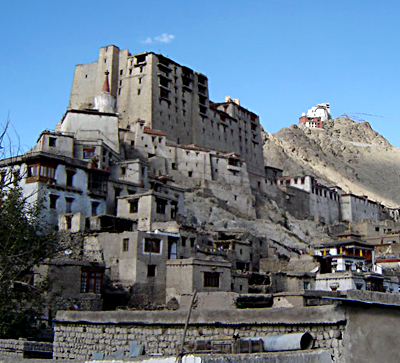
The culture of Ladakh has carried on the living heritage to the western Himalayas and the culture very much resembles the Tibetan culture. This rich cultural heritage of Ladakh is reflected on various aspects of life of Ladakhis as well as the architecture (monuments and monasteries), food, festivals, celebrations etc. The influence of India and Tibet are followed in the architectural establishments of Ladakh. Moreover, the monastic architecture of Ladakh ruminates a deeply Buddhist approach. Furthermore, one of the most important elements of the cultural life of Ladakh is the religious mask dances. The dances are the theatrical representation of the fight between good and evil. The rich oral literature of songs and poems for every occasion, and local versions of the Kesar Saga, the Tibetan national epic occupies an eminent part of the secular culture. A very important part of the traditional life of the people of eastern Ladakh is weaving tradition. Apart from region and social tradition, the Ladakh is carry admiration for sports like ice hockey, Cricket, Archery, Polo which are considered to be the traditional sports of this community. In addition to these, people of Ladakh have mastered the conception and application of Tibetan medicine, which is a fusion of Ayurveda and Chinese medicine, combined with the philosophy and cosmology of Tibetan Buddhism.

Tourism in Ladakh
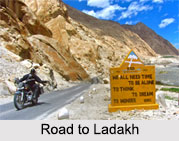
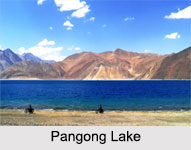
The tourism of Ladakh incorporates the adventure tourism, cultural tourism and leisure tourism. The alluring beauty of this land Ladakh, appeals the travelers for its unaltered fusion of wilderness and overwhelming natural beauty with the magnificence towering mountains and Buddhist simplicity. The places of interest in Ladakh are Leh, Drass valley, Suru valley, Kargil, Zanskar, Zangla, Rangdum, Padum, Phugthal, Sani, Stongdey, Shyok Valley, Sankoo, Salt Valley and several popular trek routes like Manali to Ladakh, the Nubra valley, the Indus valley etc. The incomparable beauty of the mountain passes including the delightful lakes girded with vivid snow surrounded all over Ladakh enhances the beauty of Ladakh. Among the mesmerizing lakes Tso Morriri Lake is an attractive lake popularly known as the `mountain lake.` Other lakes beautifying the land are the Pang Gong and Tso Kar.

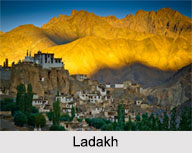
Ladakh`s beauty lies in its mountain ranges. Their crests bite into the sky with jagged saw-like teeth and from some vantage points a vista opens of peak upon peak, ridge upon ridge, stretching away as far as the eye can see and as much as imagination can conceive.

(Last Updated on : 18/07/2009)
  More on Cities of Jammu and Kashmir...
 
Gulmarg Poonch Dras
Sonamarg Tourism in Kargil Pahalgam
Akhnoor Katra Badami Bagh
Hiranagar Kukernag Kunzer
Kupwara Kishtwar Khour
Bari Brahmana Bishna Charari Sharief
Chenani Duru Verinag Gho Manhasan
Hajan Gorah Salathian Handwara
Ganderbal Khrew Ladakh
Kargil Tourism in Leh District Bazaar and Old Town
Sankar Gompa Accommodation in Leh North of Leh
Sumur Panamik Diskit
Stok Shey Tikse
Matho Hemis Tso Moriri
West of Leh Spitok Phyang
Sumtsek Lamayuru Zanskar
Recently Updated Articles in Indian Cities
  • Panchgani
    Panchgani is one of the prominent hill stations located in the state of Maharashtra in India.
  •  
  • Panaji
    Panaji is the capital city of Goa and also one of the major tourist destinations in India.
  •  
  • Idukki
    Idukki is a prominent hill-station and one of the districts of the state of Kerala.
  •  
  • Urayur
    Urayur was the capital of the early Cholas until the dynasty was revived by Vijayalaya Chola in 850CE.
  •  
E-mail this Article | Post a Comment
Free E-magazine
Subscribe to Free
E-Magazine on Indian Cities

 
Ladakh, Jammu & Kashmir - Informative & researched article on Ladakh, Jammu & Kashmir
Sitemap
Contact Us   |   RSS Feeds
Copyright © 2008 Jupiter Infomedia Pvt. Ltd. All rights reserved including the right to reproduce the contents in whole or in part in any form or medium without the express written permission of Jupiter Infomedia Pvt. Ltd.