Geographical Background of India - Informative & researched article on Geographical Background of India
  Indianetzone: Largest Free Encyclopedia of India with thousand of articles Geography of India


in  
Art & Culture | Entertainment | Health | Reference | Sports | Society | Travel
Forum  | RSS Feeds  | Free E-magazine
Geography of India : Indian Climate l Indian Mountains l Indian Forests l Indian Soil l Indian Vegetation l Animal Husbandry in India l Resources in India l Indian Demography l Indian Industries l Indian Islands l Indian Airports l Zoos in India l Indian Mines & Minerals l Indian Physiography l Indian Transport l Indian Geology l Communication in India l Indian Trade l Indian Astronomers l Indian Telecommunications
Home > Reference > Geography of India > Indian Physiography > Geographical Background of India
Geographical Background of India
The geographical setting of India has further offered a distinct dimension to the Indian tourism industry.

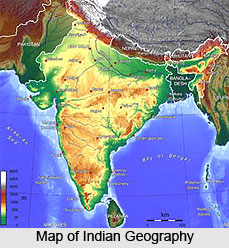
Indian along with Pakistan and Bangladesh constitutes a geographical unit. Pakistan and Bangladesh are two sub continents of India. The geographical unit consisting of India, Pakistan and Bangladesh has distinctly stood apart from the main continent of Asia. This is because of the fact that Himalayan ranges are present in the North side while seas cover the other three sides. On the other hand, the Himalayan ranges are covered by other mountains such as in the west there is Karakoram and then Hindukush. In the south of the Hindukush is covered by Sufed Koh and the Sulaiman hills. And these are separating India from Afghanistan while the Kirthar hills separating India from Beluchistan. In the East side there are Himalayan spurs that forms the Patkoi, Lushai Hills and Naga hills, with their dense forests barring access to India from that quarter. There are several passes in the Western side. The prominent route is through the Khyber. The other route, which is also famous, starts from Heart to Kandahar and finally descends into the Indus Valley through the Bolan Pass. There is a third route that passes through the inhospitable Makran desert. These passes are the way in which different invaders and merchants tried to enter into the country. The same case happened with Indians, they maintained their commercial as well as cultural contact with the people of Western Asia, Europe, China, and Central Asia.

The Northeastern Mountains maintain a gap leaving the space for the river Brahmaputra. Though it is too difficult to pass through the dense forests but still some merchants and missionaries passed through them and entered India.

Because of all these reasons and mainly because of Himalayan range India was isolated from other countries of Asia but it has always maintained the cultural and commercial contacts with the countries as well.

In the South direction there is Indian Ocean, because of which India is protected from the foreign invasion. But it is also seen that the people of the ancient India also maintained cultural contacts with many of the islands and countries through the sea.

Thus it can be seen that the country was always isolated from the rest of the world but as a matter of fact it always tried to keep in touch with the outer part of the world. Indian subcontinent is not a country but it is actually a vast geographical region whose length from the east to west is about 4,000 km and from the north to south it is about 3,200 km. The vastness of India has resulted in a variety of conditions both geographical and sociological and that is the reason why it has all the variety of climates from the scorching heat of the desert of Rajasthan to the extreme arctic cold of the snow-covered peaks of the Himalayas. The rainfall varies from the peak to the plains while there is also variation in the flora and fauna. India`s vast and varied resources have been utilized for economic self-sufficiency and independence.
(Last Updated on : 23/01/2009)
  More on Indian Physiography...
 
Geographical Background of India Southern Plateau Indo-Gangetic Plain
Five-fold division of the Indian Physiography Coastal Plains of India Doab
Eastern Coastal Plains Indo Gangetic Plain Northern Plains of India
Ecoregions in India Great Indian Peninsular Plateau Deccan Traps
Coromandel Coast Gulf of Kutch Gulf of Khambhat
Gulf of Mannar Bay of Bengal Evolution of the Indian Physiography
Indian Water Bodies Indian Wetlands Central Highlands in India
Recently Updated Articles in Geography of India
  • Grand Trunk Road
    Grand Trunk Road is one of the oldest, longest and most important roads of South-Asia.
  •  
  • Types of Forests in India
    Elevation, topography, climate and soil type are the major factors which determine the type of forest.
  •  
  • Sispara Peak
    Sispara Peak is an Indian mountain peak, situated in the south Indian state of Tamil Nadu.
  •  
  • Indian Railway Zones
    Indian Railway network is classified into seventeen zones for administrative purposes.
  •  
E-mail this Article | Post a Comment
Free E-magazine
Subscribe to Free
E-Magazine on Geography of India

 
Geographical Background of India - Informative & researched article on Geographical Background of India
Sitemap
Contact Us   |   RSS Feeds
Copyright © 2008 Jupiter Infomedia Pvt. Ltd. All rights reserved including the right to reproduce the contents in whole or in part in any form or medium without the express written permission of Jupiter Infomedia Pvt. Ltd.