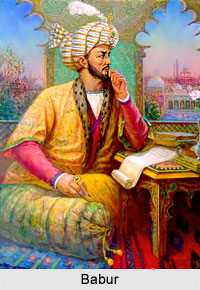
 Babur, who laid down the foundation of the rule of a new dynasty in India in 1526 A.D, belonged to the family of Chaghatai Turks. He was born on 14 February 1483 A.D. He was the fifth descendent of Timur from the side of his father. Babur invaded India several times through the border of Punjab during the Lodhi dynasty in India. He used to carry out the invasion from his capital at Kabul. Finally he won at the battle of Panipat that brought a decisive victory for him. Though the entry of Babur (which means Tiger in Arabic) was unexpected in the Indian history it created a new era that started with the long time competition with the Afghans and Rajput. The Mughal invasion displaced the dominance of indigenous Hindu Rajputs and Afghans.
Battle of Panipat
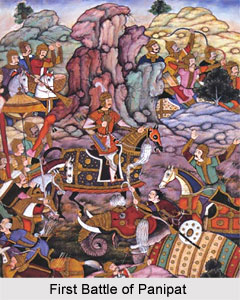
In the year 1526, the first Battle of Panipat took place at Panipat, few miles away from Delhi. Babur had only twelve thousands army while the opponent Sultan Ibrahim Lodi; the Sultan of Delhi had a much larger force. Babur was equipped with more advanced weapons, both matchlock men and field cannon, which proved to be very useful against the Afghan cavalry. Like the other Indian rulers Lodi was not also introduced with firearms. Ibrahim Lodi was killed in the battle along with dozens of other Indian chiefs. Babur emerged victorious and occupied Delhi. Then he sent his son Humayun to Agra, the capital of Lodi to capture the Royal palace and the treasure. Shortly after that Babur joined Humayun at Agra, distributed the seized treasures among his followers. Then he ascended the throne of Agra and turned it to his capital.
Battle of Khanua
 The very next war there was a battle between Babur and Rajput confederacy at Khanua. The Rajputs were led by Rana Sanga, ruler of the State of Mewar in Rajasthan. The Rajput cavalry was huge with eighty thousand soldiers and five hundred armored war elephants while the Mughal force was much smaller in size. But Babur had guns and the cavalry was well practiced with Central Asian tactics, which proved to be very effective against the Rajput. This battle also brought victory to Babur. Rana Sanga and many other renowned Rajput leaders died at battle of Khanua that ended the possibility of resurgence of Rajput power in the north India. In the year 1528 Babur marched to the great bastion of Chanderi, which was the fort of a feudal leader under the Rana of Mewar. The Mughal army attacked the fort and slaughtered many lives there.
These great victories achieved over the main powers of northern India were the base for Babur`s kingdom. From which he could consolidate his rule in Northern India. He could have withdrawn to Kabul, taking this culmination of plundering in the land of Hindustan to his own motherland. But Babur`s idea was quite different. Humayun was already sent back to Kabul to defend the city and the country against further Uzbek invasions. Babur decided to stay in the fertile land of Hindustan and to strengthen his hold over the wealthy cities. The battle of Ghaghara was the last battle of Babur in India. He had succeeded in establishing the Mughal Empire in India and there was nobody to challenge his power in northern India.
The character of Babur has been praised by all historians both modern and contemporary. Babur was adorned with various virtues and clad with numberless excellences, above all which towered bravery and humanity. He was kind, generous, courageous, chivalrous, and lovable and cultured man. He was a good judge of human nature and circumstances. He was fond of music and gardening and constructed many buildings in India. Babur was a Sunni Muslim and had complete faith in God. Babur was a scholarly king. Babur did not get time to receive proper education as he engaged himself in fighting right from the age of eleven. Yet, the knowledge he acquired and the command he had over Turkish language has assigned him a place in the world of scholars. Babur possessed good knowledge of Arabic and Persian while he was a scholar of Turki. Babur was a gifted poet and his prose memoirs, the Babur-namah have become a world classic of autobiography.
Babur was a determined soldier and an experienced general. Babur became a successful commander. He never lost courage or determination to rise. He learnt from his defeats. He learned Tulghuma warfare from the Uzbeks, ambuscade from the Mongols and the Afghans, use of fire-arm and artillery from the Persians and effective use of mobile cavalry from the Turks. Besides, he made a clever synthesis of all these tactics and stems of warfare. That made him a successful commander and therefore he won every battle in India. Besides, Babur could inspire his followers, get their loyalty and command obedience from them. He never feared fighting against larger armies than that of himself, always tried to understand the weakness and also the strength of the enemy and utilised it fully in the battle. Babur enjoyed hardships with his nobles and soldiers and was always one of them. The Mughal army became well-organised, disciplined and effective fighting force under him.
Babur died in December, 1530. His kingdom included Central Asian territories, Kabul, the Punjab, Delhi, part of Bihar at the east and Gwalior at the South. He was succeeded by his elder son Humayun.