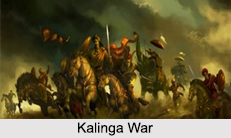
 Kalinga War is one of the most violent and dreadful wars of ancient Indian history. Its outcome became epoch-making to make it one of the most famous wars of world history. It was fought in 261 B.C. at Dhauli hill, between the great Mauryan Emperor Ashoka and the ruler of Kalinga. This Kalinga war was first and last battle ever fought by King Ashoka and it changed the way of his life totally that turned him from `Chadashok` to `Dharmashok`. It was during the Kalinga war, Ashoka earned his name "Ashoka the Great". The Battle of Kalinga began at the 8th year of Ashoka"s rule.
Sources of Kalinga War
From ancient times, Kalinga maintained her identity as an influential state. The Military power of Kalinga was also dreadful. The real influence of Kalinga was established from the truth that, though Chandragupta Maurya occupied almost the whole of India but he did not attack Kalinga which was so near to Magadha. The first two Maurya Emperors were very much aware of the military strength of Kalinga. Ashoka, the 3rd Maurya Emperor, had also to wait and set up for long 8 years after his coronation to carry out the attack to Kalinga.
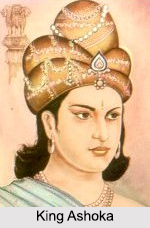 The invasion of Kalinga was essential to complete the political union of India for Maurya Dynasty. Since Kalinga region was similar to the land crossing area between the north and the south India, the survival of a powerful independent state touching upon the Magadhan territory was like a direct danger to Mauryan imperialism. Moreover, the Kalinga people dominated the Indian Ocean and controlled the abroad trade also. Their domination on the eastern seacoast almost closed the sea routes in the east for the Magadhan merchants. Also the land routes for interior trade from the Gangetic valley towards the Deccan were also controlled by Kalinga only. The economy of the Maurya Empire was thus harmfully affected by Kalinga"s domination over the seas and the eastern seacoast. The enmity between the two powers was politically and economically natural because of their existence closer to each other.
Ashoka did not follow this customary rule. The people of Kalinga took up the challenge of the invading forces in full strength of mind to defend against Emperor Ashoka who succeeded the Battle of Kalinga. The results of terrible Kalinga war saw a turning point in the history of human development.
Consequences of Kalinga War
Kalinga battle was very brutal and it is stated that around 150,000 warriors of Kalinga and 100,000 Mauryan warriors died. It is being alleged that the battle was so ferocious that in result of the battle, Daya River, flowing next to the battlefield turned completely red because of the bloodshed. Several thousands of men and women of Kalinga were deported. After the war of Kalinga, Emperor Ashoka ended his military invasions and completely stopped the territorial development policy of Mauryan Empire. After the battle, Ashoka hold the notion of "Dhammavijaya" or triumph through "Dhamma". Ashoka ruled his empire for more than 40 years with peace, harmony and affluence.
The current day Odisha and Ganjam were the prehistoric Kalinga. Thousands had died, innumerable people suffered as a result of the violence, dismissal and other eventualities of war. There were blood and tears all over the place.
Kalinga War
Kalinga War is one of the most famous battles in Indian history. It was fought between Ashoka, the great Mauryan Emperor and the ruler of the State of Kalinga.