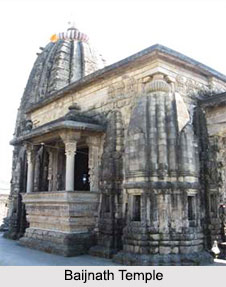
 Baijnath Temple is located in the Indian state of Himachal Pradesh. More specifically, this temple is situated in Baijnath, 16 km from Palampur in the Kangra district. Palampur is known to be a green hill station and a municipal council in the Kangra Valley and Baijnath is known to be a small township in the Dhauladhar Range of western Himalayas. The current name, Baijnath became popular after the name of the temple. This temple can also be said to be located in a popular mountain resort. People come to Baijnath Temple to worship its ruling deity, Lord Shiva. Lord Shiva is worshipped here as Vaidyanath or the "Lord of Physician" or "Lord of Therapy or Medicines". Baijnath is therefore an old temple (over 1,000 years old) of the Hindus. This temple is known by the other name of "Shiva Temple of Palampur".
History of Baijnath Temple
Baijnath Temple was constructed in 1204 A.D. The Saka year 1126 that corresponds to 1204 AD is considered to be more authentic. Two local merchants namely, Ahuka and Manyuka are credited with the establishment of this temple. In the 19th century, Raja Sansar Chand carried on the renovation work of the temple. According to the legend, Ravana, the King of Lanka had worshipped Lord Shiva in the main Baijnath Temple. It is believed that he sacrificed his head ten times at a place marked out in the temple.
Architectural Design of Baijnath Temple
Baijnath Temple is a fine representation of the early medieval north Indian temple architecture known as Nagara style of temple architecture. It is located within a well-maintained complex of gardens, lawns and pathways in a single walled courtyard. The entire temple is enclosed by a high wall with entrances in the north and south. The entrance to the sanctum of the temple is via a vestibule that is provided with a mandapa in front. The mandapa is characteristically large and in shape of a square. It is twenty square feet and four huge pillars support the roof of this mandapa. Elevated benches that together form a passage leading up to the entrance of the sanctum join the pillars. The mandapa has two massive balconies, one in the north and the other one in the south. In front of the mandapa hall there is a small porch. This porch is supported on four pillars in the front. Close to these pillars, there is an idol of Nandi, the bull, which is evidently placed in a small pillared shrine. A small human figure is noticed holding the tail of the Nandi Bull. The walls of the temple are adorned with several images that are fixed or carved on them. The outer walls of the temple have several niches with images of Gods and Goddesses. The form of Siva linga installed in the temple is called Svayambhu. This Siva linga will be evident to the visitors in the sanctum of the temple. This sanctum has been designed as having five projections on each side and is provided with a tall curvilinear Shikhara atop. It is eight feet square inside and eighteen feet outside. The sanctum is entered through a small anteroom. The ancient Baijnath Temple can therefore be said to be constructed in the Shikhara style. The temple was also found to have two long inscriptions in the porch. These inscriptions testify to the existence of a temple of Siva in the place of the present temple.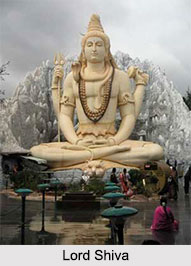
Festivals Celebrated in Baijnath Temple
Maha Shivaratri, Dussehra,Makara Sankranti and Vaisakha Sankranti are the festivals celebrated in Baijnath Temple. Maha Shivaratri translates into the "great night of Shiva" in English. Following the Hindu calendar, this Hindu festival is celebrated on the new moon day in the month of Maagha. To celebrate Maha Shivratri, there is a 5-day state level function organized in the month of March, every year. Dussehra, also known as Vijayadashmi (`Vijay` meaning `victory` and `Dashmi meaning `tenth day"), is a famous Hindu festival celebrated all over India. This festival symbolizes the victory of good over evil. According to Indian mythology, Dussehra is the day when Lord Rama killed the demon-king, Ravana and rescued his abducted consort, Sita. Today, this legendary victory is reenacted in various parts of the country. But interestingly in Baijnath, Ravana"s devotion to Shiva is honored during the celebration. Sankranti translates into "movement" in English. The festival of Makar Sankranti signifies the day when there is a significant movement in the zodiac - the arrangement of the earth"s dial around the sun.
Tourism of Baijnath Temple
The Baijnath is frequented by a large number of tourists and devotees from all over India and abroad, throughout the year. They engage themselves in special prayers that are offered to the deity in the morning as well as in the evening, on a daily basis. This temple can therefore be called the tourism product of Himachal Pradesh. Visitors will also get a chance to enjoy the serene surroundings and healthy climate of middle range hills of Baijnath. Paragliding and trekking in the area are also a fun filled possibility or option for the adventurous tourists.
Other Places of Attraction around Baijnath Temple
The Mahakala Temple Complex, Sidhanath Temple, Mukutanath Temple, Kangra Fort, Kangra Art Gallery, Bhagsunath and Jwalamukhi Temple are some of the other places of attraction around Baijnath Temple.
Visiting Information
The nearest airport to Baijnath Temple is Kangra Airport at Gaggal near Dharamshala. The nearest railhead on the narrow gauge line is at Moranda near Palampur (30 km). Baijnath is located on the Pathankot-Chakki-Manali Highway No. 20, midway between Mandi and Kangra. Roads leading to Baijnath Temple are motorable by buses and taxis. There are bus routes connecting Baijnath to all the major cities of India. Baijnath Temple is located about 54 km from Kangra in Himachal Pradesh and about 56 km from Dharamshala Binwa Baijnath Dham.
Related Articles:
North Indian Temples
West India Temples
East India Temples
South Indian Temples