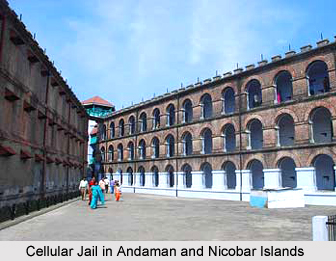
 The history in Andaman and Nicobar Islands says that the British East India Company established a penal colony where criminals convicted for crime against the Company were kept.
Prior to the establishment of British Empire in India, the Andaman and Nicobar islands were little known to the people of India because of the lack of any authentic historical account. Although according to the Hindu legend, Lord Rama once thought of the possibility of using the Andaman and the Nicobar range of islands as his war platforms against Lanka.
Claudius Ptolemaeus, the celebrated Egyptian geographer, popularly known as Ptolemy, mentions the Andaman and Nicobar chain of islands from Cape Negrais to Sumatra in his writings in 2nd century A.D. Although he himself never drew any maps, yet the earliest maps available are definitely based on his data. These are thus, called Ptolemy`s maps and refer to these islands as `Islands of Cannibals` and `The Islands of Fortune`.
The first recorded reference to Andaman and Nicobar islands is found in the monumental work Badhisattavavadna Kalpata by Kshendra, the Kashmiri poet who related how once when Emperor Ashoka the Great, seated on the throne in Pataliputra in 3rd century B.C.
Reference to these islands is also found in the writings of I`Tsing, the Chinese traveller who, while sailing from Sumatra to India, visited these islands in A.D. 673 and described the inhabitants as "Cannibals" (the man eaters).
The first distinctive notice of the Andamans is in the collection of early Arab notes on India and China, which were translated by E.W. Renandot and this account was copied by Pembcrton and Harris, in their respective publications.
The famous Italian traveller Marco Polo, a merchant from Venice, who passed by these islands sometimes in or after 1290, spoke of the Andamans as a "very long island" where "the people are idolaters and live like wild beasts". He used the word, `Andamanain` considered being an Arabic dual. May be in old times, but still contemporary with Hindu accounts, the Barren Island volcanic mountain was active. One Brahmin saint recognised it as the "Pit of Hell.` His note indicates that the Andamans were on a trade route and, therefore, a fitting rendezvous for pirates. Reference to the Andaman and Nicobar islands is also found in the works of Friar Odaric who passed by the Andamans in A.D. 1322. Nicolo Conti in A.D. 1440 calls the Andaman islands as `Andamania` which he explains to mean, `The Island of Gold`. Cesare Federici in A.D. 1569 mentions that the Andamanese were brutal by nature. The earlier mention of Nicobar islands was made by a Buddhist monk I`Twang in A.D. 673.
Towards the end of the 10th century, there was a noteworthy outburst of naval activity in south India under the strong rule of a series of great Chola kings. Rajendra Chola I surnamed as `Gangal Konda` sent his fleet across the Bay of Bengal and conquered many kingdoms in the east. The conquest of Pegu was followed by the annexation of the Nicobar and Andaman Islands, in approximately A.D. 1025. The great Tanjore inscription of A.D. 1050 mentions the name of the islands in the translated form of Timai Thevu as Nakkarum, `the islands of impurity`, and as the `abode of cannibals`.
The first attempt of settlement on the Andaman and Nicobar islands was made by French Jesuits at Car Nicobar in A.D 1711, who became the victims of unfavourable climate. In 1756, the Danish government took formal possession of the islands and established a colony on the north-east coast of the Great Nicobar. The colony was transferred to Kamorta Island in 1760, but it also perished due to severe climatic conditions. In 1766, fourteen Moravians settled on the north end of Nancowry Island with a view to colonising and extending the influence of Dutch East India Company. Within a few years, each one of them perished. In 1778, the Austrian government took possession of these islands and built a fort at Kamorta. The war in Europe forced Austrians to pull out.
It seems that about five thousand years ago, these islands formed part of a continuous range of soaring mountains extending from Negrais in Myanmar on the north to the Achin Head in the Sumatras on the south through the Coco island and were thus part of the mainland of Asia. Through some great catastrophe a greater part of the land submerged and separated these islands from the mainland of Asia.
The Andaman and Nicobar islands have originally been the home of aboriginal inhabitants. The tribes of Andaman were known as Andamanese, Onges, Jarawas and Sentinalese tribes. The tribes of Nicobar were known as the Nicobarese and Shompens. In the Andaman Islands, the various Andamanese people diversified into distinct linguistic, cultural and territorial groups.
It is mentioned that the "natives of the Andamans who are unquestionably a Negro race, are the descendants of the survivors of an Arab slave ship wrecked on one of the islands some centuries ago". Driven to desperation due to the ill-treatment the aborigines received from strangers, the tribe acquired in self-defence mercilessness and ferocity that might have been originally unfamiliar to their nature.
In the latter part of the 18th century, piracy was common near the Andaman and Nicobar islands with Nancowry being the seat of power. By deceitfulness or by surprise attacks on men landing ashore, the pirates pillaged, scuttled the boats of their victims, and murdered the crew of uncountable vessels under the British flag. In order to put an immediate end to these pirate activities, to locate suitable harbours for ships in distress and to establish a penal colony, Lord Cornwallis, the then Governor general of India in the early part of 1789, despatched Captain Archibald Blair, a renowned hydrographer employed in the East India Company and Colonel Colebrook, the Surveyor general of India to these islands to survey and report. Based on their positive report, the British government decided to establish the first ever settlement in the Andamans in September 1789 on Chatham island on the south-east bay of the Great Andamans, then named as Port Cornwallis but later re-named as Port Blair.
The colony was however not a penal settlement. It was formed on the lines of several such arrangements then in existence, like the settlements at Penang and Benkoelen to put down piracy and check the murder of ship-wrecked crews. The convicts were sent from India incidentally to assist in its development precisely as they were sent to Benkoelen and afterwards to Penang, Malacca, Singapore, Moulmein and the Tenasserim province.
The settlement flourished under Blair, but regrettably, on the advice of Commodore Cornwallis, (brother of the then Governor General of India, Lord Cornwallis) the site was shifted for strategic reasons to the north-east harbour, where it flourished at first, but subsequently suffered much due to ruthless climatic conditions. Moved by the blows suffered in the Andamans, the authorities resolved on 8 February 1796 to abolish the settlement at Port Cornwallis.
At the time of abandonment of the settlement in 1796, there were 270 convicts and 550 free Bengali settlers. The convicts were transported to Penang and the settlers were taken back to Bengal. After that, the islands remained unoccupied till the present penal settlement was established in 1858.
History of Andaman and Nicobar Islands
History of Andaman and Nicobar Islands dates back to the settlement of the East India Company in the territory of the Islands.