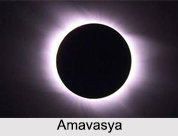
 Amavasya is also known as "No Moon Day" or "new moon day" in Hindu religion. Amavasya is known as "new moon day" as it is the previous time of full moon. It is the 15th day of the dark half of lunar month. The day on which sun and moon are in combination and Amavasya is the Indic name of new moon. It is the last day of the waning moon and is important for performing the rituals for the departed ancestors. In Sanskrit, "ama" means "together" and "vasya" means "to dwell" or "cohabit".
Myths of Amavasya
In Indian culture and beliefs, Amavasya is considered a time of great power irrespective of religions. Moon goes around the earth once in every 29.5 days. When the earth fully blocks the moon from the sun, it is Amavasya. Before the dawn of British rule in India, Amavasyas were declared as the monthly holidays. The days of dissimilar festivals and events are calculated depending on the `thithi` or lunar day. The fortnight that starts with Amavasya is also referred as the Shukla paksha.
In Hindu tradition, it is believed that during Amavasya, the negative forces and evil powers control over the earth. Amavasyas are dedicated to making the traditional rituals for the dead ancestors. There are some legends related to Amavasya. One of the stories is that of Acchoda, who the mentally conceived daughter of Barhishadha was. Since Acchoda did not have a father, she always coveted for a real father. As a result of her mortal desires, she lost all her divine and Yogic power and fell from heaven. While she was falling, she prayed to be saved. The souls from Pitru Loka (the world of forefather) heard her appeal while she was passing through the `Pitru Loka` and they immediately came to her rescue. They heard her story and advised her to be born as King Amavasu`s daughter. King Amavasu was a wise, judicious and erudite man.
Later on things happened as the "Pitrus" predicted. In the mean time, Acchoda regained her powers. Acchoda arranged a ceremony to remember the "Pitrus". Amavasya is named after King Amavasu. On this day the custom of honouring the forefathers is observed since the ancient days. "Pitrus" Karma is observed to plea the forefathers to safeguard from any hindrances and also to seek their blessings.
Types of Amavasya
 There are different types of Amavasya which has a great significance. "Mauni Amavasya" and "Mahalaya Amvasya" are very fortunate. In some regions people observe partial fast or a complete fast on the day. "Somavati Amavasya" or "Somavara Amavasya" is associated with the new moon which happens on a Monday. It is a favourable day for observing the Somavara Amavasya Vrata or fast, for the long life of their spouses.
"Shani Amavasya" is dedicated to Lord Shani also celebrated as "Chhaya Putra". "Bhaumvati Amavasya" is referred as an occurrence of "Amavasya" on a Tuesday. "Bhaumvati Amavasya" is very pleasing for worshipping planet Mars as it is believed that when New Moon falls on a Tuesday, it happens to be more fortunate on diverse chapters of life based on apology and devotion. It is generously blessed by Mars to live a blissful life.
In Tamil Nadu, people make special "Tharpanam" (Oblation) in Rameshwaram beach and other holy theerthas on "Thai Amavasai", "Aadi Amavasai" and "Mahalaya Amavasai". "Aadi Amavasai" comes in the month of July-August and is the 1st Amavasai after Dakshinayanam Punya Kaalam (Southern Journey of Sun). "Chitou Amavasya" is celebrated in Odisha in honour of Lord Jagannath. "Yellu Amavasya" is one of the major regional festivals in Karnataka. It is organised by the farming community of Karnataka.
Rituals of Amavasya
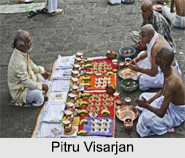
Indian myths state that Amavasya is the day for the "Pitrus", or souls of the forefathers. This day is auspicious and is dedicated to the remembrance or worshipping of the forefathers. However, no travel should be done on the days of Amavasya, as travelling without moonlight was forbidden in the ancient days in Indian myths. People also conduct `Poorna Kriya` on Amavasyas. This is generally connected with the birth of twins. The ceremony brings contentment and peace to the life of twins.
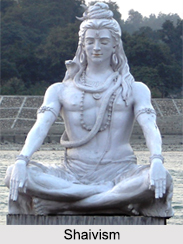
Lord Shiva is also worshiped in Amavasya as he is closely associated with moon. "Saamba Parameshwara Pooja" is also performed on the Amavasyas to appease Lord Shiva. The dark fortnight of "aswayuja" (September- October) is known as "Mahalaya Paksha". The fortnight is especially sacred for offering oblations to the departed forefathers. The last day of this waning period of moon is considered as most important day in the year for performing the rituals.