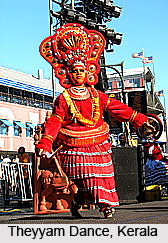
 Theyyam is one of the most outstanding and popular ritual arts of northern Kerala, particularly the area of Kolathunadu of the present Kannur and Kasargod District. As a living religious group with centuries old traditions, rituals and customs, it embraces almost all castes and classes of Hindu religion. The term Theyyam is a distorted form of `Dhaivam` or God. It is a rare combination of dance and music and reflects important features of a tribal culture as a whole. This folk dance is believed to be a divine expression and the local residents of Kerala invoke the blessings of God through this dance form. This custom is also followed in the area of Tulu Nadu in Karnataka.
Origin of Theyyam Dance
Historians are of the view that Theyyam dance is an ancient folk form and possesses characteristics which suggest that it had originated as early as the Chalcolithic and Neolithic periods. There existed certain communities who refused to accept the supremacy of Brahmins, especially in temple worship. These people were major patrons of Theyyam, and this dance used to be practised by every Tharavadu. Brahmins were never permitted to participate in this dance form, as it belonged exclusively to the regional tribal communities of Kerala. However, some royal clans erected their individual shrines where Theyyam deities were established. In domestic shrines, Goddesses like Kurathi, Chamundi, Vishnumoorthi, Someshwari and Rakteshwari are appeased. Thus this dance is also based on caste system. Nowadays, Brahmin `Thanthri` is invited to sanctify the `Kavu` idols and the Thiyyas perform this dance as a significant religious custom.
History of Theyyam Dance
It is evident that a substantial portion of this modern folk religion preserves its origins from the earliest periods of Neolithic and Chalcolithic settlement and expression, underscoring its profound antiquity. Diverse in its manifestations, Theyyam encompasses a remarkable array of approximately 400 distinct types, each with its unique identity and significance. Among these, prominent figures such as Vettakkorumakan, Kathivanoor Veeran, Vishnumoorthy Theyyam, Muchilot Bhagavathi, and Sree Muthappan stand as exemplars of this religious tradition.
The term "Theyyam" itself finds its linguistic lineage in "Daivam," signifying the divine or the sacred. This linguistic evolution underscores the deep spiritual and religious undertones embedded within Theyyam. Its origins are believed to harken back to practices rooted in ancestor worship, a foundational aspect of Kerala`s cultural heritage. Remarkably, a majority of the Theyyam deities are rooted in the lower castes of the Kerala caste system, reflecting the intricate tapestry of its historical development.
Over time, the rudimentary practices of ancestor worship have metamorphosed into the elaborate dance rituals that define Theyyam in contemporary times. This evolution has incorporated a myriad of local beliefs and customs, enriching the tapestry of this ancient and enduring tradition.
Cults of Theyyam Dance
Theyyam dance tradition, deeply rooted in the cultural fabric of Kerala, showcases a diverse range of sub-cults and religious practices. Theyyam dance, being an ancient tribal dance boasts of a widened scope which also includes the religion of Islam. At its core, Theyyam pays homage to Bhagavathi, the mother goddess, who holds a pivotal role in the rituals. Bhagavathi reigns supreme among the numerous folk gods and goddesses present within Theyyam. This enduring devotion to Bhagavathy underscores the enduring significance of female deities in the tradition. However, this multifaceted tradition encompasses various other elements of worship and spirituality, each contributing to its rich heritage.
Besides Goddesses, other cults of Theyyam include serpent -worship, tree-worship, ancestor-worship, `masathi`-worship, animal worship, Goddess of disease, spirit-worship and worship of village deity or `Gramadevataa`. `Shivani`or Durga, `Vaishnavi` or Lakshmi and `Brahmani` or Saraswati are the major Goddesses worshipped through Theyyam.
Among the prominent practices observed within Theyyam are spirit-worship, ancestor-worship, hero-worship, masathi-worship, tree-worship, animal worship, serpent-worship, the veneration of goddesses associated with diseases, and the worship of Gramadevata, the village deity. These rituals and forms of worship have been seamlessly integrated into the mainstream of Theyyam.
Theyyam`s religious foundations trace their origins to various branches of Hinduism, particularly Shaktism, Vaishnavism, and Shaivism. During the 13th century, Vaishnavism was a popular theme of Theyyam, in Tuluva region, under the reign of Vishnuvardhana belonging to Hoysala Dynasty. Shaktism and Shaivism are the other important categories of Theyyam. While contemporary Theyyam predominantly reflects these Hindu influences, the core rituals and practices have ancient roots. Notably, certain cult-centers within Theyyam still practice blood offerings, a custom strictly forbidden in Buddhism and Jainism. These centers designate specific areas outside the shrine for such offerings and for the creation of the traditional Kalam, known as Vadakkan Vathil. Interestingly, the Theyyam deities associated with cock-sacrifice do not enter these shrines. This practice highlights the intriguing cultural synthesis within Theyyam, where elements of "little" and "great" cultures converge in religious expression.
The revival of Vaishnavism in Kerala has had a limited impact on Theyyam. Only a handful of deities fall under this category, with Vishnumoorthi and Daivathar being the principal figures. Vishnumoorthi, believed to have been deified from the 13th-century champion of Vaishnavism, Vishnuvardhana of the Hoysala dynasty, finds a unique place in Theyyam. His legend is often seen as symbolizing the god`s migration from Mangalore to Kolathunadu, further intertwining regional history with religious belief.
The majority of Theyyam deities fall under the categories of Shaivism or Shaktism. This diverse spectrum includes spirits, ancestors, heroes, and animals, all elevated to divine status within the tradition. In essence, Theyyam serves as a compelling example of the religious evolution within modern Hinduism. It demonstrates the enduring significance of ancient practices and rituals, all designed to seek the blessings of the supernatural, much like the invocation of mother goddesses for fertility and prosperity in ancient civilizations, including the Indus Valley.
Patronage for Theyyam Dance
The patronage extended to the Theyyam dance tradition is rooted in deep devotion and historical significance. Ruling clans, driven by their unwavering faith, have played a pivotal role in establishing dedicated shrines and Kavus for Theyyam deities. Prominent deities like Rakteshwari, Chamundi, Someshwari, Kurathi, and Gods such as Vishnumoorthi find their revered place in these household shrines. It is during the annual festivals of these deities that Theyyam dancers make their compelling appearances, further enriching the cultural tapestry of these rituals.
It is noteworthy that the rituals performed within these shrines bear the distinct imprint of cultural fusion. This fusion can be traced back to the intricate social organization built upon the caste system and the dynamics of agrarian relations. The unique blend of indigenous Theyyam traditions with the ruling clans` patronage and influence has resulted in customs and practices that distinguish them from mainstream Brahmanical temple rituals.
In the context of this cultural evolution, it`s worth mentioning that the tradition of inviting Brahmin Thanthri (priests) to consecrate the idols within these Kavus represents a relatively recent development. This practice, while symbolizing a certain degree of cultural amalgamation, remains a notable departure from the traditional Theyyam customs and rituals.
Types of Theyyam Dance
Theyyam dance tradition, deeply ingrained in the cultural landscape of Kerala, boasts a rich tapestry of rituals and deities. There are approximately 456 distinct types of Theyyam, with 112 of them gaining particular prominence.
Muchilot Bhagavathi: Muchilot Bhagavathi is revered as a virgin goddess and serves as the guardian deity of the Vaniyas in North Malabar. According to local legends, she was born as a Brahmin woman in the Maniyottu mana of the village of Peringellur, near Taliparamba. Over time, she was elevated to the status of a deity. According to holy manuscripts (Pattola), Muchilot Bhagavathi embodies the Kaliyuga avatar of Sita Devi from Treta Yuga, Maya Devi from Dwapara Era, and Gayatri Devi, who appeared before Viswamitra Maharishi. Her connection to Muchilot pada nair, a soldier from the Muchilot clan among Vaniyas, holds cultural significance.
Kathivanur Veeran: The Kathivanur Veeran Theyyam pays homage to the memory of the valiant Thiyya community warrior, Mandhappan Chekavar.
Vishnumoorthy Theyyam: This Theyyam form is the most prominent among Vaishnava Theyyams. It recounts and enacts the narrative of Lord Vishnu`s avatar as Narasimha, which culminated in the defeat of Hiranyakashipu. Consequently, Vishnumoorthy is also known as `Narasimha Moorthi,` symbolizing the half-man, half-lion avatar of Vishnu.
Sree Muthappan Theyyam: Sree Muthappan Theyyam represents a distinctive fusion of two divine figures, namely, Thiruvappana or Valiya Muttapan (Vishnu) and Vellatom or Cheriya Muttapan (Shiva). What sets Sree Muthappan apart is its year-round performance, unlike other Theyyams. Additionally, Muthappan Anthithira is another Theyyam dedicated to Muthappan, performed only once in all Muthappan temples.
Padikutti Amma: The Padikutti Amma Theyyam is associated with the belief that she is the mother of Muthappan. It finds expression in the Palaprath Temple in Kodallur, near Parassini Kadavu, during the Malayalam month of Meenam.
Gulikan: Gulikan represents Yama, the Hindu god of death, and the Benkanakavu (Venganakavu) in Nileshwar is a prominent temple dedicated to Gulikan.
Padamadakki Bhagavathy: The Padamadakki Bhagavathy Theyyam is performed at the Koroth Temple. According to legend, the Nileswarr Raja sought the goddess`s help to thwart an invading army from Karnataka, and Devi sent Padamadakki Bhagavathy for assistance. Upon encountering Padamadakki Bhagavathy, the invading army fell unconscious, averting war.
Manakkott Amma: Manakkott Amma Theyyam takes place at the Vairajathan Temple in Nileshwar. Manakott was a woman born in a Nair family who defied the caste system of her time. Tragically, she was murdered for breaking caste rules while pregnant. Her death triggered turmoil within her family, eventually leading to its downfall. Over time, Manakkott Amma emerged as a goddess.
Kuttichathan: Kuttichathan is a renowned Theyyam associated with the Brahmin Family of Kalakatt Illam in Payyannur. Legend has it that Kalakattachan, feeling threatened by Kuttichathan`s societal influence, tore him into 396 pieces. This act resulted in the emergence of 396 Chathans who set fire to the Namboothiri`s house and nearby Brahmin residences.
Chamundi: Chamundi Theyyam manifests in three primary types, namely Madayil Chamundi, Rakta Chamundi, and Kundorra Chamundi. Madayil Chamundi, also known as Rakta Chamundi and Rakteshwari, is immersed in blood, symbolizing her victory over the Chandamundans and Raktabijasura. Kundora Chamundi, Kundadi Chamundi, and Kundoor Chamundi are variations that commemorate her battle against Darikasura, created by Velanmar.
Puthiyaramban Daivam: Puthiyaramban, the lead fighter of Allada Swaroopam, is believed to possess supernatural powers and deep expertise in Kalari (martial arts). After a great victory, he was betrayed during a Kalari match and subsequently deified. Puthiyaramban Theyyam is performed in Puthiyaramban Tharavadu, Sree Kappattu Kazhagam, Sree Kannamangalam Kazhagam, and Udinoor Kulom.
Costumes of Theyyam Dance
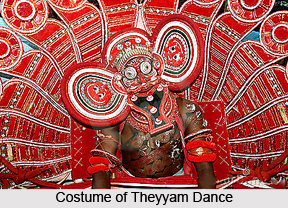
The make-up involves face painting in different styles and also body decoration. Different costumes like leaf dress or `Tazha Adai`, headdress or `muti`, `arayoda` or `Vattoda` and other body decorations are to be prepared by the artists for performance. Some of the costumes are made up of tender coconut leaves that are used only for single performance. Some head crowns and masks are used in different occasions. Preparation of these items requires proper skill and craftsmanship. Perfect knowledge of primary and secondary colour combinations is also important at times. In certain dance items a dance has to wear burning wicks around his waist and observe fire walk wearing the heavy headdress. He has to learn the method of weight distribution by moving hands, shoulders and legs. In morning hours they usually give instruction to the in experienced dancers. Oil massage is applied to the body of a young dancer.
Performance of Theyyam Dance
A training in `Kalaripayattu` is required for the Theyyam artist who performs the role of hero deities like `Kathivannur Veeran`, `Poomaruthan`, `Pataveeran` and many others. Theyyam dancers perform this dance in front of the local village shrine and sometimes also might practise it inside residences for the purpose of worshipping ancestors, accompanied by intricate customs and rituals. Curtains or stage is absent in this particular dance. Spectators are generally devotees who sit near the shrine or stand in reverence, since it is a form of open-air theatre. Performance of Theyyam dancers, who play the part of deities last for 12 to 24 hours, interrupted by a few intervals. The chief dancer of Theyyam participates in rituals associated to this dance form. He makes up the central deity of the holy place has to reside in the `aniyara` or green room. In that room he observes vegetarianism, fasting etc. as a part of the rituals. After the sunset also this particular dancer would not eat anything as a legacy of Jainism. The initial portion of the dance is termed as `Thottam` or `Velattam` and is done without any essential make-up or elaborate costume. Dancers are clad in a tiny red headdress while performing it.
Ritual song is recited by the dancers with the drummers and the name of the shrine is mentioned. In the background folk musical instruments like `Chenda`, `Tuti`, `Kuzhal` and `Veekni` are played with rhythm. All dancers take a shield and sword in their hands. Thereafter, the dancer appears with his face painted in patterns called `Prakkezhuthu`, `Kattaram`, `Kotumpurikum`, `Vairadelam` and `Kozhipuspam`. There are different types of face painting for which primarily and secondary colours are employed. Then, the dancers appear in front of the shrine and transforms into the particular deity following the performance of certain rituals. He commences his dance after placing the red headdress over his head. Carrying a sword or `kadthala` in their hands, dancers move around the shrines in circles and continue dancing. Theyyam dance has different steps known as `Kalasams`. Each Kalasam is repeated systematically from first to eight system of footwork. A performance is said to be complete when a combination of plying of musical instruments, vocal recitation, dance, makes up and costumes all work together and thus the performer gets his field.
Significance of Theyyam Dance
Theyyam theatre or Theyyam folk art has completely different rituals, which possess elaborate performances, which are totally different from the other art form. The caste councils or village elders for bringing prosperity to the village maintain the village places of worship and cult spots. In such places the village goddess or Bhagavathis named after that particular locality are appeased as an ancient practice. The Theyyam festival of that particular shrine has a meaning and purpose. The elaborate rituals observed in these holy places including the preparation of the Kalan or square are intended for blessing of the super nature. The process symbolizes the womb of mother goddesses. It is the significant aspect of the fertility cult. Offerings of cereals, cock blood, red flowers, etc are made in front of the `Kalasam` or Kalan. These rituals are responsible for the blessings of the super nature for prosperity in men and women, cattle and wealth. The dancer throws rice on the audience and distributes turmeric powder as symbols of blessings. This turmeric powder has also high medicinal value, against small pox, etc.
The entire village folk attend the Theyyam festival in the places of worship while the members of Tharavadu and relatives attend the Theyyam festivals in their Tharavadus. Some grand Theyyam festivals or `Kaliyattoms` of the `Vaniya` caste, Thiyya caste and `Maniyani` caste are followed by the common feast for the entire devotees. Different castes and communities participate in such festivals as well. They share the expenditure by means of donation. The members of the special caste who possess the holy place and offsprings made by the devotees pay compulsory charge. The elders settle major disputes and caste conflicts during Theyyam festival. It was an effective way of administration of justice in the medieval period and even continued in the days of British administration.
This art has acquired a significant place in the cultural history of the region as a religious and social institution. Under the impact of Aryans the religious belief of Theyyam had changed. Currently, it incorporates new trends and sub cults along with its tribal character. When the cult of Theyyam, borrowed liberally from Brahaminism, the Brahmins with their social and caste superiority also encouraged the Theyyam Gods and Goddesses. The Theyyam traditions and arts inherited by a son from his father, or a nephew from his uncle. This practice continued uninterruptedly for centuries.