 As per the Hindu calendar in the month of Phalguna, during late winter, sometime between the months of February and March, the Hindu festival of Maha Shivaratri is celebrated. Also known as the "Great Night of Lord Shiva", the festival of Maha Shivaratri is particularly important in the Shaivism tradition of Hinduism.
History of Maha Shivaratri
Considered to be an auspicious occasion, there have been mentions of the festival of Maha Shivaratri in ancient texts like the Puranas, particularly in the Skanda Purana, Linga Purana and Padma Purana. These Shaivite texts from the medieval era present different versions associated with this festival. In these texts, the rituals associated to Maha Shivaratri mention fasting and reverence for icons of Lord Shiva such as the Lingam.
Significance of Maha Shivaratri
There are various legends that describe the significance of Maha Shivaratri, from chanting of hymns to reading divine scriptures, there are a lot of aspects to the festival which are important. It is said that worshipping the Shiva Lingam, makes the devotees get over their past sins if any and help them lead a virtuous life and eventually reach Mount Kailasha on liberation.
According to the Shaivism tradition, Maha Shivaratri is the night when Lord Shiva performs the heavenly cosmic dance of creation, preservation and destruction. The significance of dance tradition to this festival has historical roots. The Maha Shivaratri has served as a historic confluence of artists for annual dance festivals like the Natyanjali at major Hindu temples such as at Konark, Khajuraho, Pattadakal, Modhera and Chidambaram. This night is said to be significant because as per some other legends, this is the night when Lord Shiva and Goddess Parvati got married.
Maha Shivaratri and Tantra
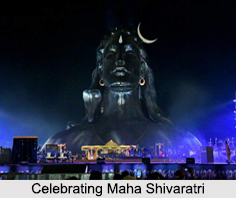
The festival of Maha Shivaratri is considered to be the day when adiyogi or the first guru awakens his consciousness at the material level of existence. According to Tantra, at this stage of consciousness, no objective experience takes place and the mind has transcended time, space and causation. It is regarded as the brightest night of the soul, when the yogi attains the state of complete Moksha or Nirvana; it is the stage succeeding Samadhi or illumination.
 Rituals of Maha Shivaratri
Various rituals and customs are related to the festival of Maha Shivaratri. Devotees observe exacting fast in honour of Lord Shiva and believe that honest worship of Lord Shiva on the propitious day of Maha Shivaratri releases a person of sins and liberates him from the cycle of birth and death. This festival is particularly fortunate for women, as married women pray for the well being of their husband and unmarried women pray for a husband like Lord Shiva, who is regarded as the ideal husband.
There are certain kind of rituals which are to be followed during this festival like the placement of 2 kalashas or pots on the eastern and western sides and 3 on the northern and southern sides. These are filled with water and perfumed with sandalwood and rosewater. On the highest level of the platform the largest kalash is placed, which represents the essence of Surya as well as the ethereal regions. The major portion of the offerings and oblations go to this level, as Lord Shiva in a way, is also Surya. Each kalash is wrapped in string netting and decorated with the bilva and mango leaves. A coconut is put on the mouth of the kalash that is draped with a single strip of cloth. The coconut represents the head of Shiva, the outer fibrous covering the matted hair of Shiva the ascetic, and the three black spots on it represents his eyes.
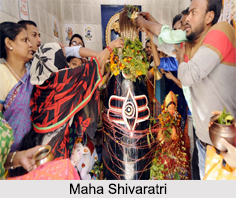
On Maha Shivaratri, devotion of Lord Shiva continues all throughout the day and night. Every 3 hours priests present ritual pooja of the Shiva Lingam by bathing it with milk, yoghurt, honey, ghee, sugar and water amidst the chanting of Om Namah Shivaya. Nightlong vigil or jaagran is also observed in Shiva temples where large numbers of devotees spend the night singing hymns and devotional songs in praise of Lord Shiva. On the following morning that devotee break their fast by partaking prasad offered to the deity.
Celebration of Maha Shivaratri in India
In the southern India, especially in the Indian state of Tamil Nadu, the festival of Maha Shivaratri is celebrated with great pomp and fanfare in the Annamalai temple of the Tiruvannamalai district. On this day, devotees walk bare foot around Lord Shiva`s temple on top of the hill for about 14 km and this process is called Girivalam or Giri Pradakshina.
The major Jyotirlinga Shiva temples of India, such as in Varanasi and Somanatha, are particularly frequented on Maha Shivaratri. They serve also as sites for fairs and special events. In Himachal Pradesh, the Maha Shivaratri Mandi fair is quite famous held in the town of Mandi, where devotes throng from all around the country. In the states of Andhra Pradesh and Telangana, yatras are held on this day and immediately after the festivities, the following days are celebrated as Brahmotsavaalu at Srisailam, one of 12 Jyotirlinga sites.
As per Kashmir Shaivism, Maha Shivaratri is celebrated by the Brahmins of Kashmir and is called Herath in Kashmiri, which means the night of Hara or Lord Shiva. In Kashmir, the ceremony of Vatuk Barun is popular, with an interesting legend surrounding it. The main purpose of the ceremony is to fill a pitcher of water with walnuts and worship it as the pitcher full of water represents Vatuka Bhairava, another form of Lord Shiva.
In Central India, the followers of Shaivism are in plenty the Hindu temple of Mahakaleshwar in Ujjain is one of the most venerated shrines consecrated to Shiva, where a large congregation of devotees gathers to offer prayers on the day of Maha Shivaratri. In Punjab, the devotees organise the Shobha Yatra, which is a grand festival among the Punjabi Hindus.
The festival of Maha Shivaratri is an important religious Hindu festival in India.