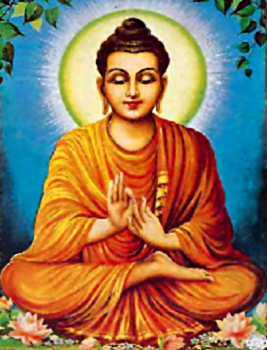
 The concept of Wisdom stands as the fifth philosophical tenet of Sadhana in the Dhammapada. It has been declared in the cannon of Buddhism that is Dhammapada an aspirant who purifies himself is worthy of attaining wisdom. The doors of meditation and concentration are open for him. He becomes free from likes and dislikes. In fact the mind of such an individual comes under control. On the other hand as wisdom and meditation are interdependent so the aspirant attains wisdom. Lord Buddha had said in his teachings that, "there is no meditation for him who lacks wisdom, nor is there wisdom for him who lacks meditation. He who possesses the meditation and wisdom both he indeed is close to Nirvana".
It has been declared in the Dhammapada that one who engages himself in those works which should be avoided and does not engage oneself in those works, which should be performed he in the process gives up his own welfare and goes after pleasure. In fact he will envy that person who has exerted himself in meditation. The advice of Dhammapada is that it is wise to remain unattached to everything because it is painful to be separated from the beloved object or person. On the other hand a man, who is unattached, has neither likes nor dislikes and is free from all kinds of bonding.
An individual who is weak in resolution, inactive, lazy and idle such a man will never be able to walk in the path of wisdom. To achieve wisdom a man should guard his speech, restrain his mind and commit no wrong by his body and only then he will be able to realise the path which has been realised by the sages. It has been said that wisdom springs from meditation and wisdom is lost from the neglect of it. Realising this two-fold path of progress and decline, a man should choose the path that leads to the growth of wisdom.
The Dhammapada has claimed that the Brahman who reaches further in both states including self-restraint and spiritual insight then all the bonds of that knowing one vanish. It has also been said that people give according to their faith and according to their pleasure. Whoever frets about the food and drink given to others he does not attain concentration or peace of mind by day or by night. On the contrary he in whom the feeling of envy and attachment is destroyed and uprooted, he indeed enjoys concentration and peace of mind.
At the same time towards the conclusion it has been mentioned that one should not despise his own gain. He should also not envy others; a person who envies others will not attain tranquility in meditation. Lord Buddha had said that the gods will praise him who leads a pure life and is not slothful in nature.