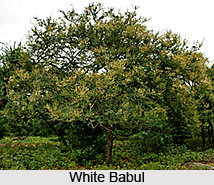
 White Babul is an Indian medicinal plant and it is native to South and Southeast Asia from Pakistan, India and Sri Lanka eastwards to Indochina, Malaysia and Indonesia. This is found in savannah or scrub vegetation and dry deciduous forests on well-drained soils at low elevations from Punjab to Bihar southwards to Tamil Nadu; particularly common on black cotton soils in central India.
White babul is also known as sated babul in Bengali, rambavala in Gujarati, safed babul in Hindi, goira in Oriya and shvetabarbura in Sanskrit. The botanical name of the plant is Acacia leucophloea. This plant is small to medium-sized, deciduous tree. The leaves are bipinnate and the flowers are yellow in colour. Fruits are flat, slightly curved, clothed with pale brown tomentum, containing 10-20 seeds. In central India flowering occurs mainly between August and October and fruiting from December to April; trees remain leafless between March-April and May-June.
Usage of White Babul
White babul is used for medicinal purposes and almost each and every part of this plant (leaves, bark, pods, gum, roots, resin, and wood) is used for medicinal usage. Some of the health benefits are as follows:
•In Ayurveda, the stem bark is considered acrid, cooling, alexiteric, anthelmintic, astringent and antipyretic; it is used to treat inflammation, bronchitis, biliousness and leprosy. It is reportedly used externally as an abortifacient among the Kathodias of Rajasthan.
•The powdered stem bark is used as a tooth powder to relieve severe toothache among the tribal inhabitants of southern Andhra Pradesh. Chewing of fresh bark daily helps to strengthen loose teeth. Also regular usage ensures arrest of bleeding from the gums.
•The gum exuded from the cut bark is demulcent and used as an emulsifying agent.
•Both the leaves and bark are capable of controlling bleeding and infection. Hence they can be used on wounds, cuts, and injuries.
•The leaves are also used for treating mild dysentery and diarrhoea. They can also be used to reduce redness and swelling due to conjunctivitis.
•The fresh pods are used for treating sexual dysfunctions such as spermatorrhea and premature ejaculation.
•The seeds and pod extracts of babul are used to control the arterial blood pressure