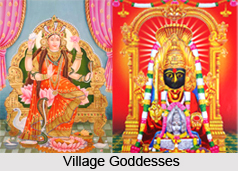
 Village Goddesses are diverse in character. Their names suggest their function. Some of the village deity possesses a regional reputation. Some of these goddesses are Mariyamman and Manasa in South India and North India respectively. Goddess Periyapalayattaman means "mother of the village Periyapalayam" is unknown outside that particular village. Generally the village deities share the names from the Sanskrit pantheon.
There are several typical characteristics of these village deities. They are generally female. These deities are not represented anthromorphic images. They are depicted in uncarved stones. At times it is seen that no shrine is there at all excepting during festivals temporary structure are built to represent the deity. These deities are worshipped with more intensity than Hindu Gods. The village Goddesses are often associated with sudden death, diseases and catastrophe. When the village suffers a calamity it is believed that the Goddess is angry with the villagers. She plays an ambivalent role.
Village Goddess predates the village and she is often associated with the navel stone that is located in the village. At times she is represented only by a head that is placed on the ground. This suggests that her body is the village itself. She plays the role of a guardian of the village. Her shrines are erected at the boundary of the village where she is supposed protects the village from invasions of evil spirits. The goddess and the village are married to each other. All castes are generally represented at her festivals. Local rooted ness of the village Goddess, narrow association with particular village is suggested. Outsiders are not allowed in the village as it is believed that the entire power of the deity is for the village and not for the outsider.
There is a straight forward relationship between the village and the village Goddess. It is believed that if the Goddess is worshipped then it is ensured that there would be good crops, timely rain, protection and fertility. It is basically a localized relationship. However these Goddesses are not benign instead they are wild and destructive. The relationship between the village and the village Goddess is very complicated.