 Vedic or Brahmanical religion had made a great progress by this time and Buddhism was slowly and gradually moving towards its decline. Vedic religion which made progress during Gupta period further progressed during Harsha`s reign. Brahmanism had divided into many philosophical schools and ascetic orders. The followers of Brahman religion worshipped cows and there were many categories of sadhu. Hiuen Tsang has also described different types of sadhu, some of them remained naked, some wore feathers of peacock, some covered their bodies with grass and so on. Some followers of Brahmanism believed in superstitious spirits etc. In the field of philosophy, Sankhya philosophy was progressing and attracting a large number of followers. Regarding multiplicity of schools and ascetic orders, Bana, in this `Kadambari` has mentioned Mukhari, Shaiva, Parashari, Bhagavat, Kapila, Kanada, Upanishads, Panchratrick etc.
Some of the prominent features and branches of Vedic religion are briefly described as:
• Shaiva religion: The Shaiva religion had made great progress during Harsha`s period. In almost every house lord Siva was worshipped. King Harsha himself was a worshipper of Shiva. Bhaskarvarman and Sasanka were followers of Shaiva religion. According to Hiuen Tsang Varanasi was the prominent centre of Shiva religion. He has described a hundred feet high statue of Siva which he saw here.
Shiva was worshipped at different places in the form of Kaleshwara, Bhadreshwara, Maheshwara, etc. Among his dreadful forms, Kaleshwara was the most prominent. There was a separate sect of the violent worshippers known as Kapalika sect, in that sect person wore garlands of bones round their neck and lived in caves and mountains. Kapalika Yati Bhairvacharya has been described all these things in `Harsha-charit`.
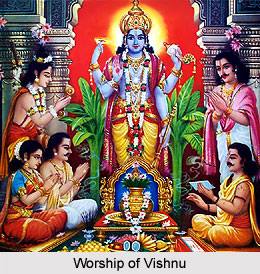
• Worship of Vishnu: Next to Shiva, the worship of Vishnu was also prevalent. There were many sects of the worshippers of Vishnu, the most prominent of which was Bhagvat sect. The reference of Krishna who was worshipped as the incarnation of Vishnu has also come in `Kadambari` of Bana.
• Worship of sun: Kings of Vardhan dynasty were the worshipper of sun god. Prabhakarvardhan, who was the father of Harsha, was a worshipper of sun. Besides being a worshipper of lord Buddha and lord Shiva, Harsha remained a worshipper of sun throughout his life. Bana has written that the people of Ujjain were the worshippers of sun.
• Worship of Sakti: Besides above mentioned gods, several goddesses were also worshipped. Among the goddesses the names of Chandika, Durga and Matrika are most prominent. Banabhatta has made specially mentioned Durgadevi. Offerings of animal sacrifice and wine to Chandika devi was prevalent.
• Yajanas: Along with the worship of many gods and goddesses, vedic yajanas were also prevalent. `Harsha charita` of Bana also refers to many yajanas in the period. Many yajanas were performed during the reign of Prabhakarvardhan it appears, however, that the prevalence of Yajanas has diminished during the reign of Harsha.
• Rites, rituals and other religious activities: To perform various rites and rituals was considered as a sacred duty by the temple. A special importance was attached to have a bath in the Ganges and giving charity. The water of river Ganges was considered very sacred and it was believed that by having a bath in it washes away all the sins. As regards charity, so much importance was attached to it that after every five years king Harsha used to give all his wealth in charity.