 Varman rule in Bengal begins with end of Chandra dynasty whose last ruler was Govindachandra. The Varmans claim to have belonged to the Yadava race, which was graced by the birth of Lord Krishna. Varman history is known from three copperplates and the Bhuvanesvara inscription of Bhatta Bhavadeva. Varman rule in Bengal was of a lesser impact as compared to some other major ruling dynasties of Bengal. Some scholars due to its claim to be descendants of Yadava dynasty suggest that Simhapura was the abode of Varmans. However this identification has been unable to gain acceptance.
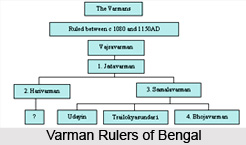
Vajra Varman is the earliest member of this dynasty. East Bengal was captured under his leadership. This seems to be referring to the conquest of East Bengal by the Varmans under his leadership. The only record mentioning Vajra Varman`s name is the Belava inscription but nothing is mentioned about this conquest. This epigraphic record does not also mention Vajra Varman`s successors. Vajra Varman, in the Belava plate is only praised as a poet, brave warrior, and an intellectual.
It was probably during the reign of Jata Varman that the Kalachuri Kama conquered Banga. His marital relation with Kama`s daughter was significant and determined the political magnitude of the Varman dynasty. The Varman rule expanded during the reign of Jata Varman, son of Vajra Varman. There was a political disturbance going on in North Bengal during Jata Varman`s rule. He led an expedition against Kaivarta Divya and won a victory over him. This victory brought him near to country of Anga.
 Though he defeated Mathanadeva, the Rashtrakuta king of Anga he was unable to permanently capture their kingdoms.
Jata Varman invaded Kamarupa and defeated its king, who was probably Harshapala. Prithu and Govardhana, who had to give up to the army of Jata Varman, cannot be identified. He was perhaps involved in a struggle with Ramapala, the Pala ruler. His other unidentified adversaries are Govardhana and the king of Kamarupa. Jata Varman issued an inscription from Vikramapura which appears to have been the capital of the Varmans.
He had two sons Hari Varman and Samala Varman who had succeeded the throne one after the other. Hari Varman`s minister of peace and war was Bhatta-Bhavadeva was Hari varman`s minister. Bhatta-Bhavadeva`s grandfather Adideva was minister of the king of Banga, who may be identified with Vajra Varman. He enhanced the cause of the Brahmanical religion in Banga. Hari Varman was probably suppressed by Ramapala. He ruled for more than forty-six years. It is unknown whether he had extended his empire to Orissa.
Hari Varman was succeeded by his younger brother Samala Varman. Samala Varman had many queens, the chief of whom was Malavyadevi, the mother of Bhoja Varman. Bhoja Varman succeeded his father and ruled for more than five years from the city of Vikramapura. Four Varman kings of southeastern Bengal are known to have ruled for about sixty to seventy years. Thereafter the decline started in the middle of the twelfth century as the Sena Dynasty ousted them during or shortly after the reign of Bhojavarman. Varmans have not extended their dominion beyond East Bengal.