 Vaishnavism has been established in India since prehistoric times, times when even perhaps Indian history did not begin its unending journey. Believed to have descended directly from the Gods, Shiva and Brahma, Vaishnavism did not take much time to attract popularity. However, besides Shiva and Brahma, Vaishnavism is out-and-out dedicated to Lord Vishnu and his associated incarnations and embodiments. Thus, the list of the Hindu Holy Trinity comes to a full circle with Brahma, Vishnu and Shiva. Originated both with legendary illustrations and pragmatic theories, Vaishnavism serves as a separatist religious faith, differentiated from Hinduism. However, legends did not just bear the heavy duty of propagating and distributing this religious belief; in order to make Vaishnavism the leading order of those times, Vaishnava religious leaders had emerged forth into the scene. Descending from legendary moments into accounted and historical eras, precisely in the pre-Christian period, an overwhelming outburst of Vaishnava religious leaders could be witnessed taking to the road in order to make Lord Vishnu or Krishna known to the world.
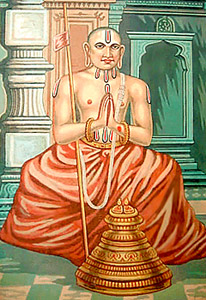
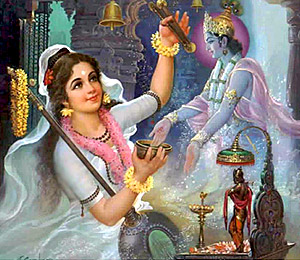 Vaishnava religious leaders belong to that cluster of men who had felt the necessity to promulgate Vaishnavism, by preaching the essential philosophies of monotheism and the study of sacred Hindu texts like Bhagavad Gita or Upanishads. Bhakti, another fundamental concept that was henceforth assimilated into Vaishnavite Bhakti Movement, bears superlative semblances with religious thoughts. Religious leaders had felt the exigency of situations in Hinduism to make themselves partitioned from dogmatism and usher in an innovative mechanism. Men like Ramanujacharya and Nimbarka belonged to those unaccounted times, when Vaishnavism was still in their nascent stage. With passage of time from pre-Christian era into post-Christian era, it was time again for Vaishnavism to take a gigantic leap into developing times.
Vaishnavism witnessed an overpowering and overmastering flow of followers in the later historical times, with the advent of Chaitanya Mahaprabhu and his devotion for Lord Krishna. In fact, it was this Vaishnava religious leader to whom much is owed in religious faiths to this date. Chaitanya had breathed in a fresh lease of life into Vaishnavism, making the religious faction a bit less dogmatic and doctrinal. The next stage in Vaishnavism, with umpteen religious leaders like Madhvacharya, Manavala Mamunigal, Vedanta Desika, Surdas, Meera bai, Tulsidas, Jnanadeva, Anandamayi Ma and Tukaram, were present only to fuel additional impetus to the already elevated Vaishnava cult and its bearings. The present age, with the founding of ISKON was almost the curtain call to Vaishnavism making to the map of leading religions in India.