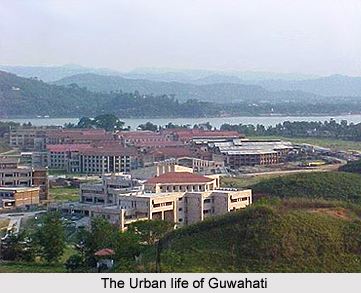
 Urban civilization in Assam was witnessed in ancient Assam in the most prominent centres which were Pragjyotishapura, Karnasuvarna, Hatappesvara, Durjjayanagar, Kamarupanagara and Hamsakonci. With the emergence of Pragjyotishapura as a political urban centre, the history of urban civilization of Northeast India began. According to inscriptions, Pragjyotishapura was the capital city of Naraka, a mytho-historical figure who came from Videha to Pragjyotisha.
It does indicate that the city was situated on the Varaha Mountain surrounded by the deep sea. After rule of Bhaskaravarman, Pragjyotisha has been shifted to Hatappesvara. Durjjaya is a westward expansion of the Pragjyotishapura. In the last part of the 12th century AD, the old city of Pragjyotishapura was extended towards the north by constructing a new capital city at the North-Guwahati area. Urban settlements gradually increased in the city of Pragjyotishapura, which reflected in the three phases of expansion.
Karnasuvarna, the capital city of Gauda, was an important centre of Pragjyotisha Kamarupa. It became an integral part of the polity for a considerable span of time during Bhaskaravarman`s rule in the 7th century AD. Shasanka who is a powerful ruler of Gauda, transformed Karnasuvarna into a splendid city and a political centre of Eastern India in the 7th century AD. Thereafter Bhaskaravarman of Kamarupa who made it "second capital city" occupied it.
Hatappesvara is also depicted as a capital city and an urban centre in the inscriptions of the 9th century AD of Pragjyotisha-Kamarupa. According to some inscriptions, the real name of the city was Hatappesvara and later it was known as Hadappesvara. The political status of Hatappesvara can be determined from the use of the terms like Jayaskandhavara and Paitamahakatakam, from the separate mention of Pragjyotisapura as a capital city of Naraka. Hatappesvara remained the capital till the rule of Ratnapala of Pala dynasty. Salastambha, the council minister of Bhaskar varman of Varman Dynasty of Assam established Hatappesvara as a new capital.
When the local cult spots were transformed into ceremonial centres with the help of the Brahmins it increased the process of urbanization in Assam. The temple of Hetuka-Sulin, the temple of Mahagauri- Kamesvara was some of the cult spots that were changed into ceremonial centres for the visitors.
An ancient urban centre at Duboroni of the Golaghat district of Assam has recently been brought to light after the independent of India. The process of urbanization in the Doiyang-Dhansiri valley began to take place along with the establishment of the capital at Duboroni, commercial harbour at Alichiga-Tengani. Duboroni played the role of centrifugal point.