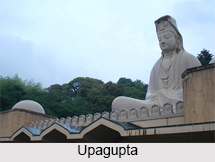
 Upagupta was a Buddhist monk of third century BC. According to some stories in the Sanskrit text Ashokavadana, Upagupta was the spiritual teacher of the Mauryan emperor Ashoka. Upagupta`s teacher was Sanavasi who was a disciple of Ananda, the attendant of Gautama Buddha.
Upagupta in Ancient Texts
Due to the absence of his name in Theravada literature it is assumed that Upagupta was a Sarvastivadin monk. In South East Asian countries and Bangladesh, Upagupta is a great cult figure. In Myanmar he is known as Shin Upagutta. In the Lokapannatti, Upagupta is sent by Mauryan Emperor Ashoka to tame Mara during an enshrinement ceremony festival, afterwards he asks her to take the physical form (rupakaya) of Buddha so that everyone at the festival can see what Gautama Buddha looked like.
Upagupta in Modern Bengali Literature
Rabindranath Tagore in his poem "Abhisar" collected in "Katha" narrates a story of Upagupta. In the story, in the month of Sraban, Upagupta was at sleep in Mathura, when Vasavdatta, the city`s diva or courtesan trips over and notices the monk. Enchanted by the handsome appearance of the monk, Vasavdatta invites him to come with her to her house. But Upagupta tells her that he cannot go with her at this point; when time comes, he will go. After a passage of seven months, when the month of Chaitra came, the city folks went to a festival out in the forest. In the lone city, Upagupta goes beyond the precincts and finds Vasavdatta severely deformed by a disease with pustules covering her body. The city people had cast her out of the city`s wall. The monk nurses the woman with care - telling her that the time for their togetherness has come. Rabindranath Tagore adopted the story with some changes from the "Vodhisattwavadanakalpalata" by Kshemendra, the 10th-11th century Kashmiri poet.