
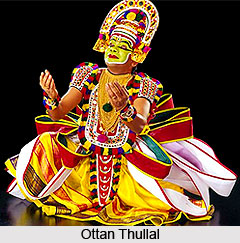
 Tullal is a dance form of enacting a story through dance and music. This originated in the early eighteenth century at Ambalapuzha. This was a small principality on the coast of the erstwhile Travancore area in south Kerala. It was invented by the trendsetting Malayalam poet Kunchan Nambiyar, who rendered his poetry based on epic themes in this newly formulated visual style. He belonged to the Nambiyar community, percussionists by profession, accompanying on the instrument called `mizhavu`. This is the traditional presentation of Sanskrit plays known as Kuttu and Kutiyattam.
Tullal Dance
Tullal is a unique and enchanting dance form of Kerala. There are three forms of Tullal which are distinguished by their different dancing styles.
Introduction
Tullal is a dance form of enacting a story through dance and music. This originated in the early eighteenth century at Ambalapuzha. This was a small principality on the coast of the erstwhile Travancore area in south Kerala. It was invented by the trendsetting Malayalam poet Kunchan Nambiyar, who rendered his poetry based on epic themes in this newly formulated visual style. He belonged to the Nambiyar community, percussionists by profession, accompanying on the instrument called `mizhavu`. This is the traditional presentation of Sanskrit plays known as Kuttu and Kutiyattam.Origin of Tullal Dance
There is an interesting story behind the origin of Tullal. During a performance the proficient Kunchan Nambiyar dozed off for a while and did not provide percussive support to the Chakkiyar actor. The Chakkiyar made fun of his behaviour with some whimsical remark. Nambiyar took offence and walked off. In protest against the Chakkiyar`s comments, he dissociated from Kutiyattam and started contemplating a different art form. Thus the concept of Tullal comes. Leaving aside the question of credibility, the fact remains that Nambiyar made his art more meaningful and appealing to the common people. This has been done by introducing a new technique of storytelling. Nambiyar was an active participant in the elitist Sanskrit theatre. Apart from his own experience in Kuttu in which social criticism and satire are of prime importance, he delved deep into the popular form of Patayani. He combined this with indigenous narration, rhythms, dance, and costumes in the total art of Tullal.
Features of Tullal Dance
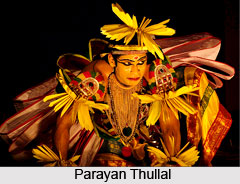 While retelling stories from the epics, Nambiyar dealt with events and experiences in his contemporary context and made the epic characters live among the people. Social commentary, humour, satire, colloquial expressions, proverbs, gave his texts immediate appreciation from the common man. Tullal has three variations namely Ottan, Sitangan, and Parayan. These are adopted by Nambiyar from Patayani characters and assigned specific costumes. There are differences in metrical structure and tempo in each style. He composed many stories in each of the above denominations, for a total of forty-one. Later authors also composed Tullal poems, but only a few made lasting impacts. All the poems came down as oral literature, finally printed only in the early twentieth century.
The solo Tullal performer sings the entire passage. It is repeated by a musician from behind to the accompaniment of cymbals and Toppi Maddalam. This is basically a cylindrical drum with both sides covered with pelt and played with the palms. He also translates the meaning of the sung text into action through dance, gestures and facial expressions. The footwork is extensively patterned to blend with the rhythms and the gestures are simple and communicative. This follows the ancient Sanskrit text Hastalakshana Dipika i.e. `Light on Hand Gestures`. This is a treatise on gestural language popular in Kerala. Malabar Raman Nair of Kerala Kalamandalam was the best-known exponent in the mid-twentieth century, followed by Vechoor Thankamani Pillai in recent times.
Development of Tullal
The term Ottan Tullal, which is a popular form of tullal dance, means jumping and running. This is a South Indian dance form that was actually created by a poet Kunjan Nambair who lived in the 18th century. The Ottan Tullal is a dance form with phenomenal success both in India and abroad. The performance of Tullal dance has various mudras, avinaya and adaus and lasts for two hours. This dance form is always preceded by the invocation to Saraswati and Ganesha. Here the dancer usually sings the song and then acts out with lines using mimes and gestures. If the dancer wishes he may leave all the singing to his musicians.
This dance form is quite informal and the dancer goes in among the audience and interacts with all the members individually. If at any point of time the dancer feels tired he can turn away from the audience while the musician continues to play. There are basically two varieties if tullals namely Parayan Tullal and Seetankan Tullal, but none of the two dance form is as common and popular as Ottan Tullal. The lyrics used in these songs are simpler and the costumes worn by the dancer is also quite simple.
There are not many people involved with this form of dance in the present times. The main reason that can be sated for the same is the fact that there is not much of a financial reward involved with this dance form considering the amount of hard work that people have to put in while singing, dancing and performance and the little reward that they get in return. One of the renowned faces of this art from was Malabar Raman Nair of Quilon.
This dance lies somewhere in between the folk dance and classical dance. The root of this dance form has its similarity with Kathakali and follows the same principles. This form of dance had a close link with the people and it played a huge role towards their relaxation and comfort.
With time the popularity of Tullal dance form has taken a serious beating and there is a serious question mark over its survival and even it is able to tide over the crisis it may not have the same popularity as it enjoyed before.
This dance form is quite informal and the dancer goes in among the audience and interacts with all the members individually. If at any point of time the dancer feels tired he can turn away from the audience while the musician continues to play. There are basically two varieties if tullals namely Parayan Tullal and Seetankan Tullal, but none of the two dance form is as common and popular as Ottan Tullal. The lyrics used in these songs are simpler and the costumes worn by the dancer is also quite simple.
There are not many people involved with this form of dance in the present times. The main reason that can be sated for the same is the fact that there is not much of a financial reward involved with this dance form considering the amount of hard work that people have to put in while singing, dancing and performance and the little reward that they get in return. One of the renowned faces of this art from was Malabar Raman Nair of Quilon.
This dance lies somewhere in between the folk dance and classical dance. The root of this dance form has its similarity with Kathakali and follows the same principles. This form of dance had a close link with the people and it played a huge role towards their relaxation and comfort.
With time the popularity of Tullal dance form has taken a serious beating and there is a serious question mark over its survival and even it is able to tide over the crisis it may not have the same popularity as it enjoyed before.
Performance Of Tullal
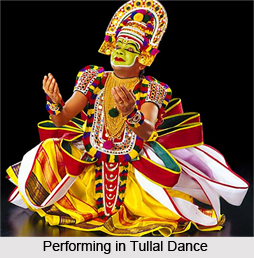 The Tullal dance form is a solo exposition, and is mainly of three types. The origin of the dance form can be attributed to a famous poet of Kerala named Kunchan Nambiar. Even though the dance form is based on the principle of Natya Shastra, but the technique is not rigid. The popularity of the tullal dance form depends on the fact that it is well written in easy Malayalam language, frank and outspoken humour and wit, the simplicity of presentation has made this dance form a popular art in everyday life.
The instruments that are used in thullal are cymbals and maddalam. The cymbal player, whose main job is to tune the rhythm, as helps the director of dancing in singing. In a live performance the cymbal player the person playing the cymbal first sings the invocation song while the dancer faces the orchestra and does obeisance. After that with his back to the audience he performs a sleek flourish of step and body movements. Afterwards we turn to the audiences and proper dance performance begins. He sings the lines and when the musician plays the chords we enacts the meaning of the lines through mimes and gestures, facial expression and body postures. The roles of the actor and raconteur are perpetually interchanged with great aesthetic efforts. At one moment he is the narrator and in the next he completely identifies himself with the narration.
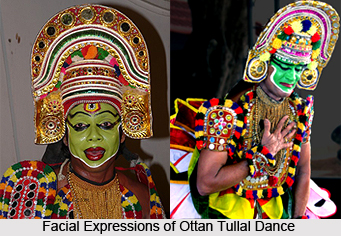
In thullal, the prime focus is given to dance itself. From the beginning to the end much of the importance is given to the dance form itself. And to overcome the monotony sometimes the dancers even execute the dance steps through vigorous steps and rhythmic movements of the body. Thullal can be divided into Ottan, Seethankan and Parayan based on the difference in dance, costume and also the rhyme and meter of the Thullal songs. The costume is impressive and peculiar. The long tape of red and white colour is hooked around the waist string to form the knee length skirt. The chest plate is decorated with many types of glass, coloured beades, ornaments and tinsel. Wooden jewellery is worn gaudily on wrist and shoulders. Above the calf muscle tinkling bells are tied and the face is painted green and lips reddened and eyes coloured with black paint. The head dress is decorated colourfully and dancers perform along with the rhyme of Ottan Thullal.
Ottan Thullal Dance
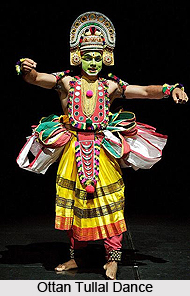 Ottan Tullal is a South Indian folk dance popular both in India and abroad. This folk dance was actually created by a poet Kunchan Nambair who lived in the 18th century. In Tullal, the performer himself sings and says the story. The troop which accompanies the main artist repeats the same when each sentence is completed.
This dance lies somewhere in between the folk dance and classical dance. The root of this dance form has its similarity with Kathakali and follows the same principles. This form of dance had a close link with the people and it played a huge role towards their relaxation and comfort. One of the renowned faces of this art from was Malabar Raman Nair of Quilon.
Origin of Ottan Tullal Dance
According to scholars, Ottan Tullal dance was created by legendary Malayalam poet Kalakkaththu Kunchan Nambiar during 18th century. As per the story, Nambiar, who was playing the mizhavu for a Chakyar Koothu show, fell asleep while performing, thus inviting ridicule from the Chakyar. The humiliated Nambiar vowed to come up with an alternative art form to Chakyar Koothu, and conjured up an Ottamthullal show that also cracked jokes on prevalent socio political equations and prejudices of the region.
The art of Tullal was not created from the vacuum. Nambiar took some help from the existing tribal performances and gave it a great shape adding his sarcastic style of lyrics. Later, he improved it into three styles as oattan, seethankan, and parayan. The three styles were derived from the performances observed by castes like "Kanian, Pulaya and Paraya" respectively. They had minor differences in their dress and style.
 Performance of Ottan Tullal Dance
The performance of Ottan Tullal dance is quite innovative and interesting. The term Ottan Tullal means jumping and running. This dance form is always preceded by the invocation to Saraswati and Ganesha. It has various mudras, avinaya and adaus and lasts for two hours. Here the dancer usually sings the song and then acts out with lines using mimes and gestures. If the dancer wishes he may leave all the singing to his musicians.
This dance form is quite informal and the dancer goes in among the audience and interacts with all the members individually. If at any point of time, the dancer feels tired he can turn away from the audience, while the musician continues to play. The lyrics used in these songs are simpler and the costumes worn by the dancer is also quite simple. The instruments used to accompany this dance are the cymbals and the Maddalam.
Development of Ottan Tullal Dance:
Earlier, this dance was mostly performed by a single actor, donning a green make-up and wearing colourful decorative costumes and reciting the Tullal lyrics, all the while acting and dancing himself. But, it is performed as a group item as well. Women too have started practicing this art form. The performance of Ottan Tullal dance is flexible; according to situation the artist has the freedom to improvise and incorporate humour.
Present Condition of Ottan Tullal Dance:
There are not many people involved with this form of dance in the present times. The main reason that can be stated is the fact that there is not much of a financial reward involved with this dance form considering the amount of hard work that people have to put in while singing, dancing and performing.
With time the popularity of Tullal dance form has taken a serious beating and there is a serious question mark over its survival and even it is able to tide over the crisis it may not have the same popularity as it enjoyed before.
Sheethankan Thullal Dance
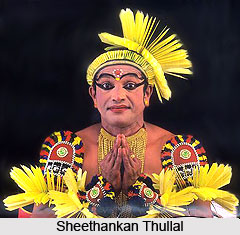 It is another form of Thullal which is performed at a little less pace than Ottan Thullal. The costumes are similar however head, arm and wrist dresses are adorned with fresh tender coconut fronds. Only the eyes are darkened and no facial make up is done.
Parayan Thullal Dance
It has the slowest tempo of all the forms of Thullal. The dancing style is also quite different where the dancer explains the songs with different gestures by standing erect. Actions are very less in Parayan Thullal. The costume consists of red, flowery cloth which is worn around the waist, a crown made of black cloth on the head and necklaces on the chest. Light yellow colour paints the face of the dancer.
Recently updated articles in Indian Dances
Koli Dance
A folk-dance form of Maharashtra, the Koli dance is mainly performance by the Koli community of the region. Known for their primary profession of fish...
Folk Dances of Nagaland
Folk Dances of Nagaland reflects the naga tradition and culture of the local habitants. In most of the cases, naga dances are monopoly of men with som...
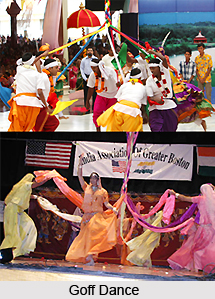
Goff Dance
Goff dance of Goa is performed during the Shigmo festival in the month of Phalgun in Hindu calendar. Goan peasants mainly practice this dance after th...
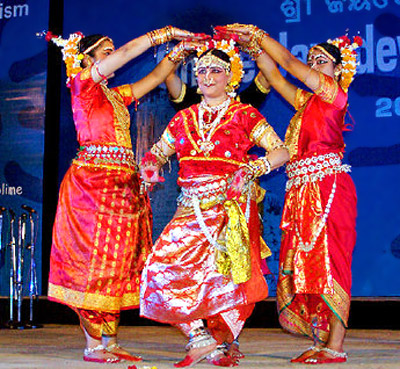
Abhinaya Chandrika
Abhinaya Chandrika is an ancient text on Odissi dance that explain every minute details of Odissi performance. The text explains about different mudra...
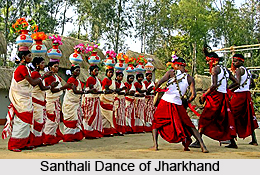
Santhali Dance
Santhali dance is a vibrant folk tradition of the Santhal tribe, reflecting the deep connection of the Santhal tribe with nature, community, and celeb...
Related articles in Indian Dances
Santhali Dance
Santhali dance is a vibrant folk tradition of the Santhal tribe, reflecting the deep connection of the Santhal tribe with nature, community, and celeb...
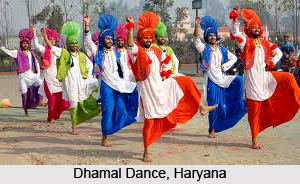
Dhamal Dance
A folk dance form of Haryana, the Dhamal Dance has its roots in the days of the Mahabharata. This dance form is primarily performed by men in the outd...
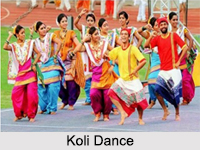
Koli Dance
A folk-dance form of Maharashtra, the Koli dance is mainly performance by the Koli community of the region. Known for their primary profession of fish...
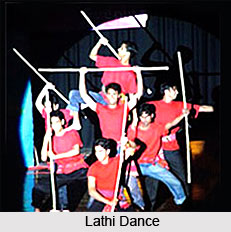
Lathi Dance
Lathi dance is a dance form of West Bengal performed on the occasion of Muharram.
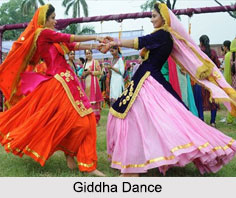
Giddha Dance
Giddha Dance of Punjab, performed only by the women, is a very popular folk art form in India. During Lohri, the Punjabi women reveal their joy throug...