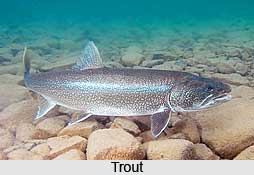
 Trout is a group of Salmonid fishes, is well known as excellent game fish in India. It is not indigenous to India but was brought by British angling enthusiasts separately into Kashmir, Nilgiris, Kodai and Munnar range of Kerala. The Brown Trout (Salmo trutta fario) was first introduced into Kashmir waters in 1900 by importing eyed-eggs (eggs grown up to development of eyes) from Scotland as a present from Duke of Bedford to the Maharaja of Kashmir. The first hatchery for breeding trout was established at Harwan near Srinagar and from there, after a few years, eyed-eggs were transplanted to many streams and lakes of Kashmir, Gilgit, Abbottabad, Chitral, Kangra, Kulu, Simla, Naini Tal and Shillong in the Indian Subcontinent where suitable cold water prevailed. Another species, Rainbow trout (Salmo gairdneri irideus) was introduced in 1912. Recently the American Brook Trout (Salvelinus fontinalis) from Canada, and a land-locked variety of Atlantic Salmon (Salmo solar) from north Americe, have also been transplanted into trout hatcheries in Kashmir.
Attempts to introduce Brown Trout in the Nilgiri hill streams were made several times after 1863 but did not succeed till importation of eggs and stock fish of Rainbow trout brought from Sri Lanka, Germany and New Zealand in 1990 proved fruitful. The same species has been thriving there ever since. In the Munnar High Range, introduction of trout succeeded only in 1932 and in Kodai hills in 1943.
The culture of trout in India can be attributed mainly to its great popularity in angling, especially in fly-fishing. Trout normally inhabit cold waters ranging from zero degree to twenty degree centigrade, though 10ØC to 20ØC is considered optimum. In the Nilgiri Hills the streams have a temperature range of 10ØC to 22ØC at an altitude of about 2100 metres, but the fish has been known to spread to lower altitudes of even 914 metres in the same hill range, where the temperature is likely to exceed 22ØC.
Normally trout is a fish of perennial mountain streams of clear cool water of high (above 6 p.p.m.) oxygen content and thrives in lakes also. As a habit it breeds in shallow slow-moving waters with gravely bottom; but because of high mortality in natural streams and difficulty of collecting the young ones, the fish is usually bred artificially in hatcheries where ripe females are stripped of their eggs and fertilized by the semen of the males. After hatching of eggs and nurture of fry to fingerling stage on artificial feeds, the fingerlings are released into natural streams for further growth. Their natural food, and that of adults also, is usually small fish, shrimps, crabs, water-insect larvae and other aquatic organisms.
The trout, in general, has an elegant spindle-shaped body with medium sized dorsal fin and a small adipose fin. The colour varies according to species and subspecies. The Rainbow Trout is iridescent and bluish, with a broad purple longitudinal stripe along the middle part of the body and back and a few red spots mostly above the lateral line and on the tail whereas the Brown Trout is brownish blue and spotted all over. The Brown Trout in its original habitat (Western Europe) rarely grows above eighty to hundred centimetres and ten to fifteen kilograms in weight; while the Rainbow is at most seventy centimetres long and seven kilograms in weight in its country of origin (America). The sizes depend on the quantity and quality of food and water. Both species mature after three to four years and produce two hundred to three hundred eggs. In India, they spawn in winter and the eggs hatch out in early spring after twenty five to fifty days of incubation, depending on temperature and oxygen content of the waters. In cold countries they spawn after winter.