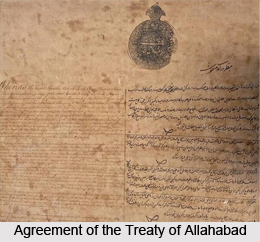
 Treaty of Allahabad was the most important historical incident where the power of jagir of Bengal was transferred to the British East India Company in India. From Treaty of Allahabad, the three villages of Bengal under Saborno Roy Choudhury- Gobindapur, Sutanati and Kalikata were transferred to the British East India Company to make the future capital of India- Kolkata.
Signing of Treaty of Allahabad
Treaty of Allahabad was signed on 16th August 1765, between the Mughal Emperor Shah Alam II, son of the late Emperor Alamgir II, and Lord Robert Clive of British East India Company, as a result of the Battle of Buxar of 22nd October 1764.
Importance of Treaty of Allahabad
Treaty of Allahabad marks the political and constitutional involvement and the beginning of the rule of British East India Company in the early era. The first phase of the rule of British East India Company began from Bengal, Bihar and Odisha.
Terms of Treaty of Allahabad
Treaty of Allahabad was based on the terms of the agreement. Shah Alam granted the East India Company Diwani rights, or the right to collect taxes on behalf of the Emperor from the eastern province of Bengal-Bihar-Odisha. Thus East India Company got appointed as the imperial tax collector for the Eastern province.
Rights to British East India Company
Treaty of Allahabad allowed the British East India Company to collect revenue directly from the people of Bengal, Bihar and Odisha. In return, the Company paid an annual tribute of twenty-six lakhs of rupees while securing for Shah Alam II the districts of Kora and Allahabad. The tribute money paid to the emperor was for the maintenance of the Emperor`s court in Allahabad. The accord also dictated that Shah Alam be restored to the province of Varanasi as long as he continued to pay certain amount of revenue to the Company. Awadh was returned to Shuja-ud-Daulah, but Allahabad and Kora were taken from him. The Nawab of Awadh also had to pay fifty-three lakhs of rupees as war indemnity to the East India Company.
Penalty to the Mughal Emperor
Treaty of Allahabad stressed the Nawab of Awadh, Shuja ud Daulah to pay a war indemnity of 5 million rupees to the Company. Moreover, the two signed an alliance by which the Company promised to support the Nawab against an outside attack provided he paid for services of the troops sent to his aid. This alliance made the Nawab dependent on the Company.
Related Articles
West Bengal, Indian State
Tribes of West Bengal
Culture of West Bengal
Tourism In West Bengal
Crafts of West Bengal
Cities of West Bengal
Medieval History of Bengal
History of West Bengal
Kolkata, Indian City, West Bengal
Culture of Kolkata
History of Kolkata
Economy of Kolkata
Modern History of Kolkata
Modern History of Kolkata