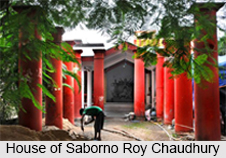
 Sabarna Ray Chaudhury was the zamindar of Kolkata, prior to the arrival of the British East Indian Company in India.
On 10th November 1698, the family of Saborno Roy Choudhury transferred, by lease, their rights over the three villages like Sutanuti, Kalikata and Gobindapur to the British East India Company.
Origin of Sarborna Roy Choudhury
The origin of Sabarna Ray Chaudhury is traced back in the 10th Century, when Adisura brought five Brahmins to Bengal. Vedagarba was one of them and is regarded as the first in the genealogy of the Sabarna Roy Choudhury Family.
Family of Sabarna Ray Chaudhury
Panchanan Gangopadhyay of the family acquired the Khan title from the Mughal Emperor Humayun in the sixteenth century, for his bravery as a cavalry in charge of Pathan soldiers. Around the middle of that century he constructed a palace at a place which came to be known as Haveli Sahar or Halisahar. It was from Halisahar that the family spread far and wide, including, to Uttarpara, Birati, Barisha and Kheput.
Bengal under Medieval Era
Lakhsmikanta Gangopadhyay alias Laksmikanta Roy Choudhury, was given jagirdari of a vast tract of land by Raja Man Singh, in 1608. Along with the Jaigir he was given the title of `Ray` and `Choudhury` which later became the surname of his descendants. It is said that he constructed many temples at Halisahar, and the original centres of habitation of the family at Goghat and Amatia. The construction of the pilgrim path from Halisahar to Barisha is also credited to him.
Villages of Sabarna Ray Chaudhury
The three villages of Sutanuti, Govindapur and Kalikata were part of a khas mahal or imperial jagir or an estate belonging to the Mughal emperor himself, whose jagirdari rights were held by the Sabarna Roy Choudhury family. The British East Indian Company was surrounded by thirty-eight villages held by others. Although in 1717, the British East India Company was permitted by the Mughal emperor Farrukhsiyar to rent or acquire zamindari rights in them, it was impossible to procure the land from the zamindars or local landlords.
Clashes with British East India Company
Even the Sabarna Roy Choudhury family was not keen to allow the British East India Company to settle or do trading on these villages, but the British had paid a bribe at the Mughal Durbar to ensure that the deal did not fail. Just prior to their move to Barisha, the Roy Choudhury family had to transfer their rights over Kalikata in 1698, to the East India Company much against their wishes and protests.
`Right to Rent`
The British East India Company ultimately got The `Right to Rent` or lease of three villages for an annual rent of Rs. 1,300. A copy of the deed can be seen at the Sabarna Sangrahashala at Barisha.
Related Articles:
Kolkata
West Bengal, Indian State
Tourism in Kolkata
History of Kolkata