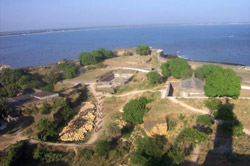
The commanding stone Fort of Diu (to the west of Diu Town) is a `tourist password`, meaning one starts to explore the place from here. Encircled by the sea on three sides, it stands lofty, like an island of courage with ominous canons atop, directing in different directions. One can still spot a couple of piles of iron shells inside. Rising from between the grand structure is a Lighthouse, which gives the fort an air of obscurity, particularly during winter nights when there is fog and the wick of the lighthouse gas flame grows faint. Erected between 1535 and 1541, following a coalition between Bahadur Shah and the Portuguese to defend the Gujarat Sultanate from an imminent attack by the Mughal Emperor Humayun. The fort`s facade wall has five gigantic windows with stone galleries.
From the fort, one gets a pictorial view of another stone structure in the sea, called the Fortress of Panikotha (Fortim Do Mar, to the west of Diu, north-east of the Diu Fort), which can be reached only by a canoe or a motor-launch. Situated approximately one nautical mile from the Diu jetty, it also has a lighthouse and a tiny 17th century chapel dedicated to Our Lady of the Sea. Curiously, legend has it that Fortim Do Mar was once joined to the land by a sub-sea tunnel.
Rivalling the Diu Fort in its impressiveness is the St Paul`s Church (north-west to the fort), constructed in 1610. The white composed structure spells quietude and calmness. Ornamented with oddly treated helices and shell-like motifs with exquisite woodcarving, St Paul`s Church is considered the most luxuriant of all Portuguese churches in India. The Church is dedicated to Our Lady of Immaculate Conception. Floodlights illumine the church`s facade during the evening.
Adjoining it is the old St Thomas` Church, erected in 1598, which has now been transformed into a museum. The passageway to the daunting structure is a languid sprawl of stone staircases, sloped at a specific angle; the enticement to sit on this stone cushion is as much as reaching the gates of the Gothic St Thomas` Church. If not for anything else, one must visit it for the collection of extraordinary wooden statues of saints in diverse sizes. Entry is free for every visitor. Timings are from 8 a.m. - 9.30 p.m. The church is open on all days.