
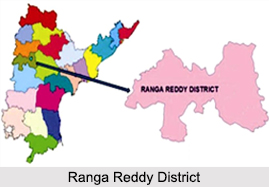
 Ranga Reddy District in Telangana is located in the central part of the Deccan plateau and is among the 23 districts of Telangana. The district has been named after the deputy chief minister of Andhra Pradesh K.V Ranga Reddy. On the 15th of August 1978 the Ranga Reddy district was formed. Ranga Reddy district can be called the rural hinterland of Hyderabad, the capital city of both Andhra Pradesh and Telangana as it feeds the region with its supplies of raw materials.
Ranga Reddy District
Ranga Reddy District, an important district of Telangana is a melting pot of various cultures and traditions.
Introduction
Ranga Reddy District in Telangana is located in the central part of the Deccan plateau and is among the 23 districts of Telangana. The district has been named after the deputy chief minister of Andhra Pradesh K.V Ranga Reddy. On the 15th of August 1978 the Ranga Reddy district was formed. Ranga Reddy district can be called the rural hinterland of Hyderabad, the capital city of both Andhra Pradesh and Telangana as it feeds the region with its supplies of raw materials.History of Ranga Reddy District
Under the rule of the Nizams of Hyderabad the district of Ranga Reddy was formed in the year 1948. In the early years, the district was known by the name Hyderabad Rural District. Later on the new district with the name Ranga Reddy was formed by carving out the twin cities of Hyderabad and Secunderabad and some urban areas of Hyderabad district was included within the realm of Ranga Reddy district.
Geography of Ranga Reddy District
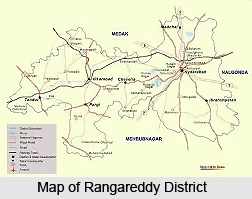 Ranga Reddy District in Telangana is located in the Central Part of the Deccan Plateau and lies between 16 degree 30 minutes and 18 degree 20 minutes of North Latitude and 77 degree 30 minutes and 79 degree 30 minutes of East Longitudes.
Extension of Ranga Reddy District : Geography of Ranga Reddy District in Telangana is mainly dictated by its location. Ranga Reddy District is bounded on the North by Medak District, East by Nalgonda District, South by Mahabubnagar District, and West by Gulbarga District and North West by Bidar District of Karnataka State. It covers an area of 7564.88 Sq. Kilometres.
Ranga Reddy District in Telangana includes present Hyderabad Urban District that was formerly known as Atrafe-Balda District and was a part of the Gulshanabad, Medak Division (Subah). Ranga Reddy District covers an area of 7564.88 Sq. Kms.
Landforms of Ranga Reddy District : Ranga Reddy District can be divided into three broad basins. A major part (about 65 percent) of the District is covered by the Musi River Basin which rises in Ananthagiri Hills. It flows from West to East, passes through Hyderabad city and flows towards Nalgonda District within the limits of which it joins the Krishna River near Wadapalli (Wazirabad) The next largest basin in the District is the Kanga Basin, a tributary of Bhima River and all new irrigation projects are proposed in this basin. The third basin in the District is the Manjira basin, which is part of the Godavari river basin where the area under irrigation is very limited.
Climate of Ranga Reddy District : Climate of Ranga Reddy District is characterised by a hot summer and is generally dry except during the South west monsoon season. The year may be divided into four seasons: March to May is the summer season; June to September constitutes the South-West Monsoon season, October to December form the North East monsoon season and January to February is the winter season. Ranga Reddy District has a normal rainfall of 781.5 mm. the bulk of which is received through the South-West Monsoon during the period from June to September. The mean maximum temperature begins to rise from the middle of February and reaches a maximum of about 30 degree C in May. With the onset of the South-West monsoon into the District early in June, there is appreciable drop in temperatures and the weather becomes more pleasant. December is the coldest month with the mean daily maximum temperature at 28.6 degree Celsius and the mean daily minimum Temperature at 13.6 degree Celsius. During the South-West monsoon season the relative humidity is generally high, ranging between 70 and 80 percent on the average. Humidity decreases from the post-monsoon season onwards. The driest part of the year is the summer season when the humidity is generally between 30 and 35 percent in the afternoon. Winds are generally light to moderate with some increase in force during May and South West monsoon season.
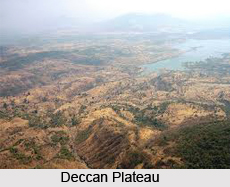 Due to the low rainfall and inhospitable soil conditions, the district cannot boast of any important timber-yielding forests. The inferior type of forests (from economic point of view) yield only thorn, fuel and small timber which the soil can sustain. In the Eastern portion of Ranga Reddy District, the forests are mostly restricted to isolated hills while in the western portion, they are confined to the slopes of the hillocks and plateau. The Forest area of Ranga Reddy District forms about 7.63 percent of the total geographical area. The situation of the state Capital in the midst of the District and the high density of population have great bearing on the development of these forests in Ranga Reddy District. The forests of Ranga Reddy District have therefore, receded and generally restricted to hills and slopes where in plough cannot work easily.
Flora and Fauna of Ranga Reddy District
It is on record that, in 1900s Ranga Reddy District with its low shrubby jungles was the home of leopards, bears, hyenas and occasionally tigers while in the more opened plains the antelope were in plenty. The game reserves for the ruling family in the erstwhile Hyderabad State and were stocked with them for the exclusive enjoyment of the nobles. Now the forests have receded into narrow pockets and so also the game. Blackbuck, Chital or Spotted deer and Sambar can still be seen in Rasanam (Rasanam), Dharur (Gingurthi) Tattepalli, Nagulpalle and Thirumalapur (Thirmapur), Gokafeasalwar (Rangampally) Naskal Forest blocks, Wild boar is found all over the forests. Jackal and fox are common even now in the open. Also, Peacock and jungle fowl are seen in Ananthagiri block. Partridges and wild pigeons are common. In the cold season, wild duck, geese, teal and snipe can be seen in the small and large tanks of the District.
Soil of Ranga Reddy District
Red soil predominates in the district followed by Black Cotton soils. The Mandals where more than 50 percent of the villages have Red-Chelka soils are Medchal, Shamirpet, Qutubllapur, Keesara, Hayathnagar, Saroornagar, Uppal, Ghatkesar, Rajendranagar, Pargi, Doma, Shamshabad, Serilingampally, Malkajgiri, Balanagar, Kulkacherla and Gandeed. Dubba soils are largely found in Manchal, Yacharam, Maheshwaram and Kandukur mandals besides Red Chelka soils. The mandals where the soils are predominantly black are Chevella, Shahbad, Vikarabad, Newabpet, Dharur, Pudur, Tandur, Peddemul, Yalal, Basheerbad, Marpally, Mominpet and Bantararm.
Agriculture of Ranga Reddy District
The variation is the fertility of the soils is the main cause for the difference in the cropping pattern of the eastern and western regions in the District. While white Sandy loams occur in the eastern region (Hayathnagar and Ibrahimpatnam), Black cotton soils predominate the western region (Chevella, Pargi, Vikarabad, Marpally and Tandur).The principal crops of the District are jowar, paddy, Ragi, castor and pulses. The food crops account for 83.1 percent and the non food crops for 16.9 percent to the gross area sown in the district. Grape cultivation makes the district occupy the distinct place in the state. Wells form the principal source of irrigation in the district.
Minerals of Ranga Reddy District
In this District, quartz and felspar are the principal minerals. The extensively exploited quartz veins are in the Mandals of Medchal, Maheshwaram, Rajendranagar, Malkajgiri and Pargi. Feldspar, the 2nd principal mineral, is also available in the mandals of Medchal, Hayathnagar, Maheshwaram, Rajendranagar and Malkajgiri around the District Head quarters. Puller earth is also available in Chevella, Vikarabad and Tandur Mandals. Limestone is available mostly in Tandur and Marpally Mandals. In Tandur Mandal, quarries of Lime Stone are extensively developed and the lime is sold locally. Lime Kanker is also available in the villages of Ibrahimpatnam Mandal and it is used as Lime Mortar for building purposes. Clays of different type are also available in Tandur area.
Demography of Ranga Reddy District
 According to the census of 2011, the Ranga Reddy District has a population of 24, 46,265. The density of population in the district is 468 persons per square kilometre and as far as the number of males and females are concerned. The literacy rate in the district is 76 percent according to the census of 2011 among the literate population more number of males are literate than the females.
Culture of Ranga Reddy District
Ranga Reddy District has forever been known as a meeting ground for different civilizations, cultures, languages, religions, traditions and races. This is because the district has been closely influenced by both the districts of Hyderabad and Secunderabad. The predominant culture that is witnessed by the people of the district is mostly a cosmopolitan urban culture as people from various parts of India migrate to the region for economic as well as academic purposes.
On the other hand the culture in the rural areas of Hyderabad still follows the age old traditions. They are orthodox in nature and yet at the same time modern in their outlook. Hence it can be said that Ranga Reddy district is an amalgamation of traditional and hi-Tech culture.
On the other hand the culture in the rural areas of Hyderabad still follows the age old traditions. They are orthodox in nature and yet at the same time modern in their outlook. Hence it can be said that Ranga Reddy district is an amalgamation of traditional and hi-Tech culture.
Education of Ranga Reddy District
The education of the Ranga Reddy District not limited to schools and colleges. Besides the basic educational institutes the district has a number of universities which caters to the higher education of the people of Ranga Reddy. Some of the well known universities of the district are Central University of Hyderabad at Gachibowli, Jawaharlal Nehru Technological University at Kukatpally, NALSAR (National Academy of Legal Studies And Research) University and A.P. Agricultural University at Rajendranagar.
Economy of Ranga Reddy District
The predominant occupation in the district of Ranga Reddy is agriculture. The main crops which are grown in the region are cotton, maize, sugar cane, ground nut, red gram, etc. Leaving aside agriculture, the other activities which are practiced by the farmers of the sub-urban areas are horticulture, vegetable cultivation and dairy farming.
Tourism in Ranga Reddy District
 Tourism in Ranga Reddy district in Telangana is a truly enriching experience as it has been the meeting ground for various civilisations and religions through the ages. Woven into its landscape are the most ancient and the most modern of structures - some made by myth and mystery and the others the handiwork of man. A number of tourist attractions, both religious and otherwise are seen all over the district. Some of the most popular places of tourism in the district are discussed below.
Pilgrimage Tourism in Ranga Reddy District
Pilgrimage tourism in Ranga Reddy District of Telangana includes the tourist sites like Maheshwaram, temple complex at Sanghi, Keesaragutta and many other pilgrimage tourist importance sites.
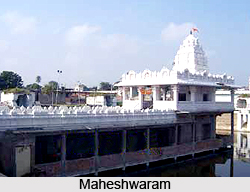
Maheshwaram : Maheshwaram is a popular tourist site located in the district. The remains of a magnificent temple of Lord Shiva are found among the ruins left by the ravages of time. Apart from the main temple, Maheshwaram also has two fortresses- Shiva Ganga and Vishnu Ganga- the Kacheri house of Akkanna and Madanna, famous ministers of Bhaktha Ramdas era, the Kodanda Ramalayam, and the Shivaji Durgam. Every edifice here bears the imprint of more than 500 years of history. The temples here house many exquisite and detailed sculptures.
Chilkur : Nestled in an arm of the beautiful Himayath Sagar Lake the little village of Chilkur is not only scenic but is also held sacred by the people of the region. The ancient temple of the Lord Balaji is located on an excellent spot by the side of the lake and is increasingly attracting devotees of God as well as of nature. The National Deer Park here is an attempt to protect and nurture the beautiful fauna of the land.
Temple Complex at Sanghi : The temple complex at Sanghi is a marble marvel built by the Sanghi family. This magnificent temple is situated at Sanghi nagar, 26 kms from Hyderabad. Sculpted by the renowned craftsman Sri Ganapathy Stapathy, this temple complex - `Paramanandagiri`, has temples of Lord Hanuman, Lord Venkateshwara, Lord Rama, Lord Ganesha, Lord Kartikeya, Goddess Durga and Goddess Ashtalakshmi. A visual delight, this temple complex has an ambience of serenity and sanctity.
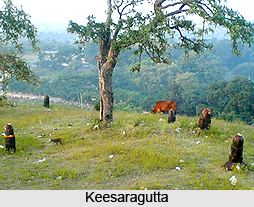
Keesaragutta : Keesaragutta, a unique hillock with a thousand Gods, is well known as the place where Lord Rama worshipped Shiva ages ago. The temple here, with over a thousand years of history, has a unique sand sculpture in the sanctum sanctorum. The archaeological museum here houses artefacts dating back to the 4th century. Keesara is a testament to the Artefacts of the land.
Nature Tourism in Ranga Reddy District
A surprise feature in the rocky, brown landscape of the Ranga Reddy District is the Anantagiri hill range. This startlingly beautiful hill station is an ideal and upcoming summer resort. With ancient cave-like structures and bathing ghats, with the temple of Lord Ananta Padhmanabha built centuries ago by a Muslim king - this is yet another place that bears testimony to the glorious history of the land.
Durgam Cheruvu : Among the many lakes that dot the Ranga Reddy District and the twin cities, Durgam Cheruvu is the most unspoilt and quietest. Surrounded by the unique rock mounds that mark the plateau, the `cheruvu` or the lake makes for a welcome get away from the noisy urban milieu. Boat rides on the lake, games and food stalls add further to the atmosphere of relaxation here.
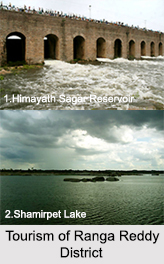
Himayat Sagar Lake : The Himayat Sagar Lake is located at a distance of 24 kms from Hyderabad and it is the chief source of drinking water for the people in the region. The placid and unpolluted waters of the lake are located in a placid surrounding which makes the site a welcome respite for those looking for some rest and relaxation.
Shamirpet Lake : Shamirpet Lake is a huge lake. It attracts a lot of visitors who come here to breathe in the fresh air and soak in the coolness of the place. Located at a distance of 42 kms from Hyderabad, it is an easy spot to reach for a rejuvenating weekend in the guest houses by the lake.
Leisure Tourism in Ranga Reddy District : Leisure Tourism in Ranga Reddy District includes the spots like Rajasthani Village, Ramoji Film City, Ghoomar-Jhoomar and many other sposts.
Ramoji Film City : The Ramoji Film City is the world`s largest film city. It offers excellent and comprehensive facilities for filmmaking. The guided tours through the fantastic landscapes are a major attraction here.
Dhola ri Rani :
 The Dhola ri Rani is a resort with a difference. Located 22 kms away from Hyderabad, it is a visually a typical Rajasthani Village. Complete with a temple, Ghoomar-Jhoomar the amphitheatre for performing arts, Kund- a swimming pool and the Maan Manuhar- the chowki style restaurant with ethnic cuisine, lawns a dance floor and the artefact shop. All these make for a functional blend of the ethnic and the modern.
Hi-Tech City : The most happening place for Information Technology lies in this part of the globe. Home for IT giants like the IBM, Microsoft, Oracle, GE, Motorola etc., the Hi-tech city in Madhapur is the symbol of man`s capacity and skill in the ever expanding frontiers of knowledge. Providing a great contrast to the historicity of the land, this technological hub is an energetic and creative response to the contemporary needs of the country and the world.
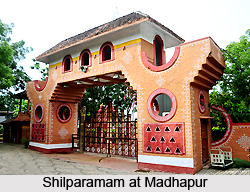
Shilparamam : With the backdrop of the Hi-tech city building, the symbol of the most modern skills of man, Shilparamam at Madhapur showcases the age old, exquisite arts and crafts of the state of Andhra Pradesh and the country. Spread over 50-acres of land and only 6 years old, this village has given a tremendous boost to arts and crafts and has become a commercial heaven for artisans. A thousand varieties of handicrafts are sold here by the craftsmen themselves. There is an amphitheatre for folk arts with daily performances and thousands flock here to savour their cultural, artistic, and aesthetic heritage.
Ocean Park : Ocean Park is a world class amusement and water theme park located in the Ranga Reddy district, right in the middle of the plateau. A number of activities of pure fun with a variety of water rides are available - sliding, rafting, going zip-zap-zoom, carousing in the wave pool and many more. Ocean Park offers variety of fun things to do in water, on land and in air for people of all age groups. It is situated just 15 kms from the state capital at Gandipet in 20 acres of landscaped gardens.
Runway-9 : Runway-9 is a popular tourist attraction in the district famous for adventure sports. India`s first and a state-of-the-art Go-Karting facility, Runway-9 is on a 5 acre plot in Kompally on the National Highway-7. Runway-9 has a full scale 711 metres concrete track conforming to international standards. Illuminated at night, the track is attached to a huge grandstand that includes a club house with multiple restaurants and other facilities - pool parlours, archery range, even a play centre for children making it an ideal family recreation centre.
Ranga Reddy district therefore has a lot to offer the traveller. It is dotted with places of tourist attraction not just for religious or historical interest, but also promises to be a fun-filled ride for those looking for some adventure.
Recently updated articles in States of India
Bandare Waterfalls, Meghalaya
Bandare Waterfalls in South Garo Hills, Meghalaya, is a secluded natural attraction surrounded by dense subtropical forests and rugged mountain terrai...
History of Thissur District
Early History of Thissur District explains flourishing of the port cities. Now these port cities are transformed into archaeological sites.
Tippi Orchid Research Centre, Arunachal Pradesh
Tippi Orchid Research Centre in Arunachal Pradesh is renowned for its rich collection of exotic and endangered orchids. Surrounded by lush rainforest...
Tourism in Nashik District
Pilgrimage tourism in Nashik district involves visiting the various places of Hindu and Jain worship located here. Some of the holiest sites for Hind...
Mangadu, Kerala
Mangadu in Kerala’s Kollam district is a significant megalithic site known for its urn burials, cist burials, menhirs, and stone circles. Excavations...
Related articles in States of India
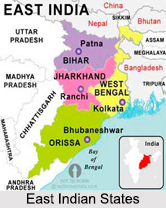
East Indian States
East Indian States comprises of Bihar, Jharkhand, West Bengal, Odisha and also the Union Territory of Andaman and Nicobar Islands. It defines the cult...
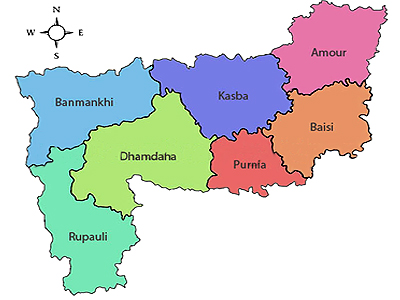
Purnia District in Bihar
Purnia District is located in Bihar and extends from River Ganga to Nepal. The district has a rich Hindu history and glorious past.
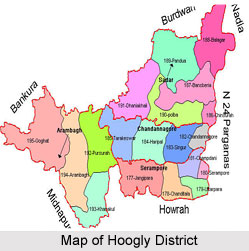
Hooghly district
Hooghly District along the bank of the river Hooghly is one of the principal trading ports of West Bengal.
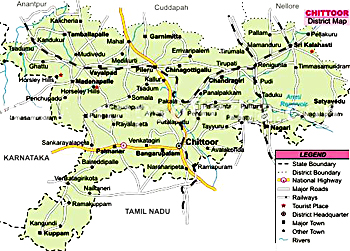
Geography Of Chittoor District
Geography of Chittoor district is spread along the topography of the land which is divided into two natural divisions; Chittoor has a dry and healthy...
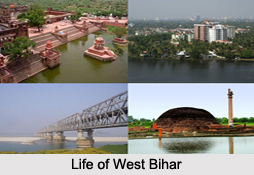
Districts of West Bihar
Districts of West Bihar is comprised of medieval monuments that were built by the different governors of Mughal era.