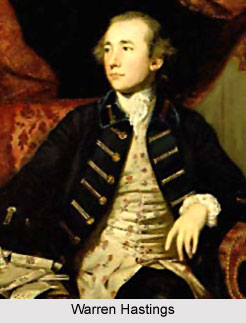
 From the attainment of Diwani, the Company was striving to establish an equality of status with the Indian rulers. Warren Hastings`s wars against Mysore and the Marathas were fought with the objective of establishing an equality of status quo with the Indian rulers. In doing this company followed a tactical policy and a number of buffer states emerged out. The buffer states emerged initially with the idea of defence of the frontiers of the Company. In short the buffer states emerged with the idea of defence of the neighbors frontiers for safeguarding their own territories. The principal threat to the company`s supremacy was the Afghan and the Maratha powers. To safeguard against these threats, the Company undertook to organize the defence of the frontiers of Oudh. However this policy was based on the condition that the Nawab would defray the expenses of the defending army. The defence of Oudh constituted the defence of Bengal at the same time.
With the arrival of Wellesley, the Company`s relations` with the Indian states underwent a massive change. Wellesley sought to reduce the Indian states into a position of dependence on the Company. He aimed at bringing the Indian states under the jurisdiction of British political power and the military protection. This policy may be described as the extension of the policy of "ring fence". Wellesley described his policy as purely defensive and pacific, for that time he was planning to extend the boundary of the British Empire. The rulers of Hyderabad, Oudh, Hyderabad, Mysore and the lesser states accepted the Subsidiary Alliance. The defeat of the Marathas in 1803 and Holkar in 1805 virtually established the supremacy of the British power. The subsidiary Alliance policy was nothing but the diplomatic tactics of the company to extend the British supremacy.