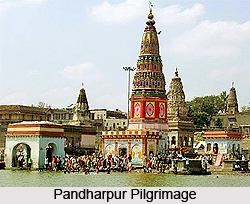
 The Pandharpur pilgrimage is closely associated with the cult of Vithoba and with the long ancestry of the poet saints of Maharastra. The abhariga literature composed by the Pandharpur saints constitutes the real `scriptures` for all the Maharastrian Vaisnavas.
The Pandharpur saints themselves are idolised and worshipped as proponents of the way to salvation and as embodiments of the grace of the Lord. This keen devotion to the saints is a characteristic of medieval Vaisnava bhakti. The unusual side of the Maharastrian bhakti is its unique link between the saints and Vithoba of Pandharpur, as well as the kind of relationship which is set up between them. There is a strange figure of Pundalik, which stands at the head of this ancestry because he is said to have brought Vithoba to Pandharpur. But according to the abhariga literature, it is believed that it is not only for the sake of Pundalik alone but for the sake of all the saints that Vithoba chose to wait on the `brick` forever. Among these Pandharpur saints, i.e. among the composers of the abhahgas, Jnandev is considered to be the first and Tukaram is said to be the greatest. Jnanadev was the author of the Jnanesvan and Tukaram is said to be a humble Kabi of Dehu who lived in the seventeenth century.
Pandharpur is said to be the city of saints, the place where all the saints and all those who endeavour to follow them have always congregated. The famous biennial pilgrimage to Pandharpur during the Asadhi and the Karttiki ekadasis is said to be a way for them to meet all the poet saints of Maharashtra congregated in Pandharpur. The pilgrims gather in Pandharpur not only to have a glance of the joined feet of their beloved Vithoba on the `brick` but also to meet be with all the saints in their holy city.
This Pandharpur pilgrimage is a form of mass communion in front of the god Vithoba and in the presence of his beloved saints. During each procession, the pilgrims escort a palkhi, a decorated chariot carrying the padukas of their particular saint, whom they joyfully carry to Pandharpur. The Marathi speaking pilgrims coming mainly from the north carry by the Tapti and in the south by the Krishna Rivers bring twenty-eight main palkhis. The Pandharpur pilgrimage is a uniquely Maharashtrian phenomenon and is more than a religious performance. This pilgrimage is said to play an important role in developing a national consciousness among the Marathas, who form the majority of all `Varakaris`.
In spite of its proximity with the Kannada linguistic boundary, Pandharpur can hardly see any procession of pilgrims from the Kannada area and from the Konkani speaking or Telugu speaking areas. The two extreme groups from the south western one and the north-eastern one make out themselves in having their `leaders` some non-Vaisnava saints or deities. The pilgrims from Nagpur carry the palkhis of Sri Bhutesvar (another name for Siva), Rukmim (worshipped as a goddess in Berar), Sankar Mahadev (another name for Siva) and Sesanarayana, the great naga which, in Maharastra, is regularly associated with the Siva linga. The palkhis of Macchindranath and Gorakhnath, the two earliest gurus of the Nath Yogis, a Tantric Saiva sect come from Kolhapur.
The most famous palkhis brought in Pandharpur are those of Jnandev from Alandi and Tukaram, the greatest abhariga poet of Maharashtra, from Dehu, near Poona. Both the Marathi Namdev and the Hindi Namdev, author of the hymns recorded in the Guru-Granth of the Sikhs are considered to be the `founder saints` and real pillars of the Pandharpur cult.
The palkhis of the saint Nivriti starts from Tryambak near Nasik, a famous Saiva pilgrimage centre, which was the place of his own initiation. There are three palkhis of Muktabai, which carry her padukas, all situated on the southern bank of the Tapti River in East Khandesh i.e. in the extreme north of the area drained by the Pandharpur pilgrimage. The palkhi of Ramdas, a seventeenth century saint who was the guru of Sivaji and himself a staunch Saiva and a devotee of Tulja Devi of Tuljapur, Sivaji`s family goddess is carried to Pandharpur from the Satara district, which is in the southern part of the Western Ghats. Another Vaisnava pilgrimage for Pandharpur consisting of mainly a number of Saiva saints and devotees starts from Tuljapur.
The pilgrims who are aiming to Pandharpur walk along with the saints placing his feet on their footprints. The Vaishnava pilgrims of Pandharpur sing all the way to reach there goal. It is believed that the deity Vithoba himself stands on his brick waiting for the devotees with ardent expectation and longing.
The huge numbers of the Varakans who march the long road to Pandharpur, following their palkhis are from all the castes of Maharastra, especially the low-castes. Most of them were Saiva by birth or tradition but they have somehow become `Vaisnavas` as they have recognized Vithoba. These saints address their beloved god as their `Father and Mother` and they regard Pandharpur as their maker, the one and only true home of all the saints. Hence, when the Pandharpur pilgrims and the saints leave the place, it becomes a moment of painful separation for them.