 One among the five eminent Deccani Sultan kingdoms which arose following the disintegration of the Bahmani Sultanate was the dynasty of the Barid Shahis of Bidar situated about 740 km north of Bangalore and 130 km northwest of Hyderabad. Qasim Barid was the prime minister of Mahmud Shah Bahmani (1482-1518 A.D.) who was a very weak king and the real power was in the hands of the former. Qasim Barid`s son Amir Barid too was prime minister and wielded a lot of power and clout. Following a succession of fragile administrative of the Bahmani rulers he virtually became the king of Bidar, but did not formally assert his independence. His son Ali Barid who ruled till 1580 was the first king of Bidar who assumed the title `Shah`.
In January 1565, all the Decanni Sultans (except Berar) joined together against the Vijayanagara emperor Rama Raya and defeated him in the battle of Rakshasi Tangadi (Talikota). However, Ibrahim Adil Shah II of Bijapur invaded Bidar and after defeating Amir Barid Shah III, the last Sultan of Bidar annexed this kingdom to Bijapur in 1619 A.D.
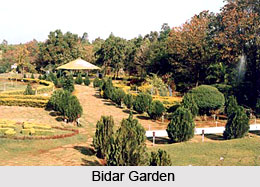
Well-known for its art and architecture, Bidar city has numerous mosques, gateways and gardens that reveal the trends of the Muslim style of architecture of that age. The Fort walls cover an area of six miles round, and have numerous gates, bastions and turrets which are still intact. The most significant of these bastions is theMunda Burj.
Khwaza Mahmud Gawan, a distinguished Persian scholar who was also the general of Mohamad Shah III, founded a Madrasa in 1472. It is a remarkable three-storied building with minarets, arches, and tile work. The Jami Masjid and the Sola Kumbha Masjid are the two best-known mosques in Bidar. Amir Barid one of the rulers of Bidar, was very cultured. He was very fond of calligraphy and poetry.
Amir Barid`s tomb, which is in Bidar and also the Rangin Mahal, is a testimony to his interest in architecture.The tiled tombs of the Barid Shahis is outside the town walls. One of the most popular crafts for which Bidar is known today is the Bidriware, a delicate metal ware containing silver and gold inlaid on iron.