
 Panna district is one of the most beautiful districts in the state of Madhya Pradesh. This district is also known for its temples which strikes a very fine blend of Hindu and Muslim architecture. Panna is the most sacred pilgrimage for the followers of the Pranami sect all over the world. With a sanctuary for rare wild life and fauna and a diamond mine, Panna has transformed a royal past into a vibrant and lively present. The Panna district is divided into 5 revenue blocks in which there are 1048 villages and 6 towns. Panchayat-wise, Panna has one Zila Panchayat and five Janpad Panchayats.
Panna District
Panna District is known as for its diamond mine in the state of Madhya Pradesh in India.
Introduction
Panna district is one of the most beautiful districts in the state of Madhya Pradesh. This district is also known for its temples which strikes a very fine blend of Hindu and Muslim architecture. Panna is the most sacred pilgrimage for the followers of the Pranami sect all over the world. With a sanctuary for rare wild life and fauna and a diamond mine, Panna has transformed a royal past into a vibrant and lively present. The Panna district is divided into 5 revenue blocks in which there are 1048 villages and 6 towns. Panchayat-wise, Panna has one Zila Panchayat and five Janpad Panchayats.History of Panna District
 History of Panna district records the rich and glorious past of the district and the rulers who ruled over it. Engulfed in the magnificence of royal legacies of its past, the district of Panna in the Indian state of Madhya Pradesh is infectious, reverently mysterious, enveloping and holy.
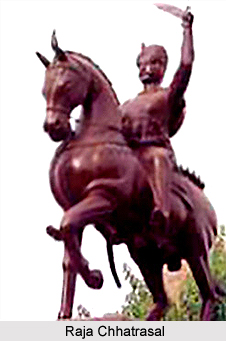
The oldest reference to the Panna district is seen in the great Hindu Epic Ramayana written by the sage Valmiki and several Indian Puranas. The ancient name of this district was Padmawati-Puri, mentioned in the Vishnu Purana and Bhavishya Purana. In the 41st sarg of Valmiki Ramayana it is described as Kilkila-Khand by Sugreev and Shrimad Bhagwat calls it Kilkila Pradesh. As per the local belief, it was the capital of Raja Dadhichi and of Raja Padmavat during "Satyug". Swami Pran Nathji who told Budelkhand Kesri Maharaja Chhatrasal (a Bundeli warrior who chose to turn against one of the well famed Mughal Emperors, Aurangzeb and seek to establish his own kingdom in Bundelkhand), regarding Diamond mines of Panna. Thus, he strengthened his financial position. He also persuaded Chhatrasal to make Panna his capital and arranged his coronation there.
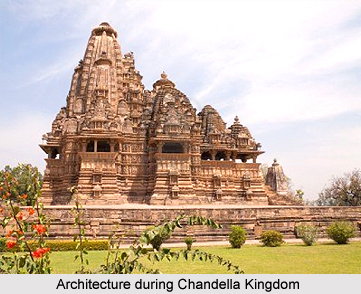
The district formed a part of the vast Maurya Empire, Sunga Dynasty and Gupta Empire. From the middle part of the 10th century AD to the second half of the 13th century, the kingdom of Chandella Dynasty included Kalingar, Khajuraho and Ajaigarh. When the Bundelas came to power in the 17th century, the area came to be known as Bundelkhand.
The Panna district of today has been carved mainly out of former princely state of Ajaigarh and princely state of Panna. It was originally a Gond Tribe settlement up to the thirteenth century. Later this district raised its to importance by Raja Chhatrasal Bundela who made it his capital. From explorations of the Archaeological survey of India, it is proved that primitive men inhabited the district of Panna in the earlier pre-historic period. During period of the Ramayana, the Panna region seems to have been included in the great Dandkaranya.
Later in 19th century, the kingdom of Panna went to Harde Sah, the eldest son of Bundel warrior Raja Chhatarsal. From that time, the Panna district became a princely state of British India. It gained control to the states of Sohawal and Nagod. Raja Nirpat Singh assisted the British East India Comapny in the Sepoy Mutiny 1857. Later after 1858, when the British Government took the total possession on India, they rewarded him with the title "Maharaja". After the Independence of India in the year 1947, Maharaja Mahendra Yadvendra Singh agreed to surrender to the Government of India on January 1, 1950. From that, time onwards, the Panna District of the new Indian state of Vindhya Pradesh. Vindhya Pradesh was merged into Madhya Pradesh on November 1, 1956.
Geography of Panna District
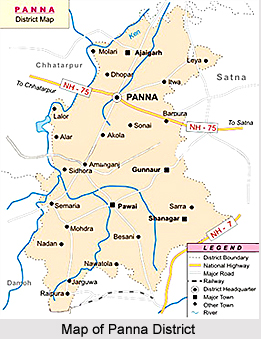
Panna district is situated in the northeastern parts of Madhya Pradesh state. It forms the northern district of Sagar Commissionerate Division. The district extends between 23 degrees 45 minutes and 25 degrees 10 minutes in the North Latitudes and between 79 degrees 45 minutes and 80 degrees 40 minutes in the East Longitudes. The shape of the Panna district is roughly triangular. From Bhopal, the capital of Madhya Pradesh, Panna is about 500 kilometres by rail route (up to Satna District), around 400 kilometres by road and around 40 kilometres by air route. The nearest airport is Khajuraho, the world famous heritage. Khajuraho is directly connected to the national capital, New Delhi by air. Khajuraho airstrip is only 45 kilometres from Panna. The nearest Railway station is Satna. It is directly connected to Bhopal, Jabalpur and Delhi and from Satna it is situated at a distance of 70 kilometres.
Demography of Panna District
 The Population Census in 2011 revealed that Panna District had population of 1,016,028 of which male and female were 532,866 and 483,162 respectively. The population of Panna District constituted 1.40 percent of total population of Madhya Pradesh. The population density of Panna district is 142 people per sq. kilometres. Panna district administers 7,135 square kilometres of areas.
Education in Panna District
The average literacy rate of Panna District was 66.08 percent. The male and female literacy rates were 75.63 and 55.55 respectively. The total literates in Panna District were 565,120. The male and female literacy rates were 339,312 and 225,808 respectively. There are private and government colleges in Panna and most of them have humanities as one of the subjects. The government as well as private bodies run schools in this district. Government schools are clustered into groups and the centre of the group is a Higher Secondary or a High School under which a number of middle and primary schools come. There are 229 middle schools, 834 primary schools, 237 vocational schools, etc.
Economy of Panna District
Though famous for its rich Diamond mines, the district of Panna is industrially a backward district and hence the State Industries Department has placed it in the `C` category. The District Industries Centre has established small-scale industrial areas at Satna Naka Panna and Udyog Giri Puraina Panna. Most of the inhabitants in Panna District earn their livelihood in engaging themselves in stone mining. While the others are engaged in making Coal Brackets, Chlorinated Paraffin Box, Ice, Edible Oil, Agricultural Implements, etc.
Temples of Panna District
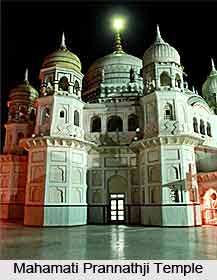 Temples of Panna district are well-known all over the state of Madhya Pradesh and present a fine blend of Hindu and Muslim architecture. The district of Panna is the most sacrosanct pilgrimage for the followers of the Pranami sect world over. The dominant architectural schemes of a majority of the temples are uniformly homogenous. After the decline of the Mughal Empire, Muslim architectural wisdom appeared in these temples like; domes of these temples are plain as well as onion shaped. The temples in the district of Panna have kalasha on top and most of the tallest domes have a lotus form.
One of the most famous temples in the Panna district is the Mahamati Prannathji temple. This is the most prominent temples of pranamies which reflects their religious and social life. The construction of the temple was completed in A.D. 1692. It is believed that Prannathji lived here and will remain here and thus became the highest Pranami tirtha as Mahamati`s Punyasthali, and hence Panna is the `param dham` for Pranamies. This temple reminds one of the great Taj Mahal at Agra. The Rang Mahal has eight pahals and each pahal possesses 201 domes. The spherical central dome is as Muslim architecture and the lotus form on this dome is as per the Hindu tradition. The glistering divine golden kalasha is accompanied by the divine panja which denotes Mahamati`s blessing and signifies the Aksharatita Purna Brahman. The main entrance of central dome is known as Kaman Darwaza, made of silver. On Sharada Purnima every year, thousands of people gather at this temple to celebrate the Mahotsava.
Another temple of importance is the Baldeoji temple. It is constructed in the Paladian style as a scaled down replica of St. Paul`s Cathedral in London under the supervision of Mr. Manly, an Italian expert. The temple structure improves upon the Romanesque and Gothick styles prevalent in Britain in 18th Century. This temple consists of a large hall called maha mandapa with massive pillars and is erected on a raised platform so that one may obtain darshan even from out side the main gate. The attractive image of Shri Baldeoji is made in black shaligrami stone. This temple is the finest building in Panna and represents the zenith of architecture of the Panna district.
Padmavati Devi or Badi Devi temple is also well-known in the district of Panna as an important place of pilgrimage. It is situated on the northwestern corner near Kilkila River and it is believed to be a very old temple. The temple has great historical and religious importance under the belief that goddess Padmavati, who was still alive was the protector of prosperity and happiness of Panna. During Nav-Durgotsava, thousands of devotees gather here. Maharaja Chhatrasal Bundela accepted the Goddess as the Raj Lakshami although their kuldevi is Vindhyavasani.
The Jugal Kishoreji temple is the main Hindu temple in the district of Panna and was erected in the Bundela temple style. The natya mandapa, garbha griha, bhog mandapa and pradkshana path are present in this temple. The attire of the Lord is not Brij but Bundelkhandi. According to the common belief, the idol came to Panna from Vrindavan via Orchha. Apart from these temples there are various other temples of great importance in the district of Panna. Some of these temples include Ram-Janki temple, Swamiji temple, Sarang temple, Baiji temple, Govindji temple, etc. All the above temples are located in the Panna town itself except Sarang temple, which is about 20 kilometers from the town.
Tourism of Panna District
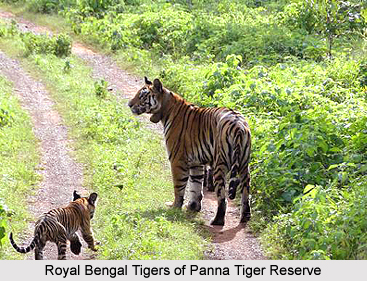 Tourism of Panna district offers a number of options including several temples, waterfalls and the most famous Panna National Park. The district of Panna is the most revered pilgrimage for the followers of the Pranami sect world over. With a sanctuary for rare wild life and fauna and a diamond mine, this district has transformed its royal past into a vibrant and lively present. Roll-on meadows dotted with evergreen trees, hills and forests and the famous temples strike a very fine blend of Muslim and Hindu architecture.
Pilgrimage Tourism in Panna District : There are many temples of Panna District. The Mahamati Prannathji Temple in Panna district is the most important temple of Pranamies. This temple reflects their social and religious life. It attracts number of devotees during Sharada Purnima. It is believed that Mahamati Prannathji lived at the site for eleven years. After that, he attained "Samadhi" inside one of the domes of this temple. The temple was built in 1692 and has Muslim and Hindu architectural styles in its domes and lotus formations. The temple is divided into six parts namely Shri Gummatji, Shri Bangalaji, Shri Sadguru Mandir, Shri Baijurajji Mandir, Shri Chopada Mandir and Shri Khijada Mandir. The prime attraction of this pilgrimage site is Shri Gummatji Temple. It is a circular building with nine marble domes. There are eight of these domes representing the eight directions and central dome has a divine golden "Kalasha". There is also a great temple gate called Kaman Darwaza, which is constructed by using silver metal.
Padmavati Devi or Badi Devi temple is another temple of great importance, which is located on the north-west corner near Kilkila River. It is believed to be a very old temple. It has also the great religious and historical importance. Another temple is the Baldeoji Temple, which is in the Palladian style as a scaled down replica of St. Paul`s Cathedral in London under the supervision of Mr. Manly, an Italian expert. The Jugal Kishoreji temple is the most prominent Hindu temple in Panna district. It was constructed in Bundela temple style. Nat Mandapa, Bhog Mandapa, Garbh Griha and Pradkshana path are present in this temple. Some of the other temples of importance in this district are Lord Ram-Janki temple, Sarang temple, Swamiji temple, Baiji temple, Govindji temple, etc. The dominant architectural plan of most of the temples is uniformly homogenous. After the declination of rule of Mughal Dynasty in India, Muslim architectural wisdom appears in these temples.
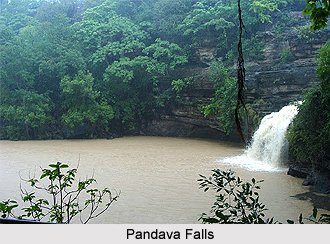 Nature Tourism in Panna District : The district of Panna is rich in waterfalls and scenic views. Panna is located on the Vindhyachal Ranges, which give Panna several beautiful sites. The beautiful waterfalls like the Pandava Fall, Brihaspati Kund, Nachne, Nand-Chand, etc. are some of the attractions in this district. The Pandav Fall is about 12 kilometers from Panna towards Khajuraho. This fall is situated inside the Panna National Park but very close to the national highway. It is a perennial fall, which is fed by local springs. Lush green surrounding makes the fall spectacular. At the foot of this fall there are some ancient caves overlooking a large pool of water. About 100 feet high, the fall has a beautiful picnic spot. Another fall in Panna is the Gatha fall. It is located on the other side of the highway. About 300 feet high, this fall is very impressive and presents a very pleasant sight from the road itself.
Leisure Tourism in Panna District : Panna Tiger Reserve is the twenty-second Tiger Reserve of India and fifth in the Madhya Pradesh state. It is located in the Vindhya Mountain Range and spreads over the Panna district and Chhatarpur district in the north of the state. The Ken River, which flows through this Reserve, is a home for maggar, gharial and other aquatic fauna. The Reserve is open for visitors for eight months in a year, i.e., from the month of November to June. Indian Teak (Tectona Grandis), Madhuca, Diospyros melanoxylon, Buchanania lanzan, Anogeissus latifolia, Lannea coromandalica, A. pendula, Boswellia, Acacia catechu, Aegle marmelos, Zizyphus spp., Butea, Sterculia urens, Gardenia spp., Dendrocalamus strictus, common bamboo, etc. are the major flora of this area. The animals like Royal Bengal Tiger, Leopard, Wolf, Wild Dog, Sloth Bear, Wild Boar, Samber, Chital, Hyena, Nilgai, Chausingha, Chinkara, Porcupine, Rusty Spotted Cat, Jungle Cat, Hare, Rattle, Gerbil, Tree Shrew, etc, are seen in the National Park. About 200 species of birds have been identified which include host of winter migratory birds. Aquatic Animals including crocodiles are found in the Ken River besides host of fish species, turtles and others.
Recently updated articles in States of India
Bandare Waterfalls, Meghalaya
Bandare Waterfalls in South Garo Hills, Meghalaya, is a secluded natural attraction surrounded by dense subtropical forests and rugged mountain terrai...
History of Thissur District
Early History of Thissur District explains flourishing of the port cities. Now these port cities are transformed into archaeological sites.
Tippi Orchid Research Centre, Arunachal Pradesh
Tippi Orchid Research Centre in Arunachal Pradesh is renowned for its rich collection of exotic and endangered orchids. Surrounded by lush rainforest...
Tourism in Nashik District
Pilgrimage tourism in Nashik district involves visiting the various places of Hindu and Jain worship located here. Some of the holiest sites for Hind...
Mangadu, Kerala
Mangadu in Kerala’s Kollam district is a significant megalithic site known for its urn burials, cist burials, menhirs, and stone circles. Excavations...
Related articles in States of India
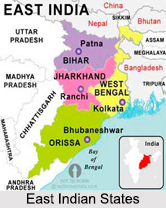
East Indian States
East Indian States comprises of Bihar, Jharkhand, West Bengal, Odisha and also the Union Territory of Andaman and Nicobar Islands. It defines the cult...
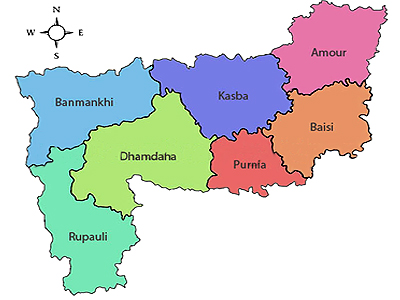
Purnia District in Bihar
Purnia District is located in Bihar and extends from River Ganga to Nepal. The district has a rich Hindu history and glorious past.
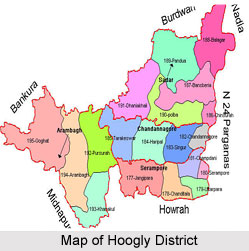
Hooghly district
Hooghly District along the bank of the river Hooghly is one of the principal trading ports of West Bengal.
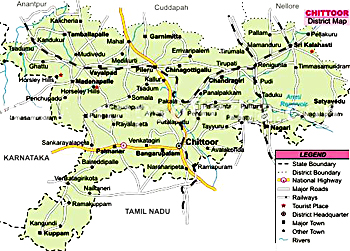
Geography Of Chittoor District
Geography of Chittoor district is spread along the topography of the land which is divided into two natural divisions; Chittoor has a dry and healthy...
Districts of West Bihar
Districts of West Bihar is comprised of medieval monuments that were built by the different governors of Mughal era.