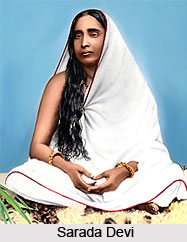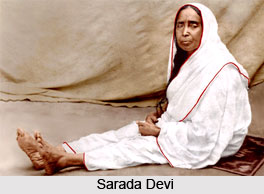
Sarada Devi

Sarada Devi is known for her motherly nature and as the consort of Ramakrishna Paramhansa.

Introduction

Sarada Devi, Wife of Ramakrishna Paramhansa"Learn to make the whole world your own. No one is a stranger . . . the whole world is your own" - Sarada Devi

Sarada Devi, the consort of Ramakrishna Paramhansa, was a pious lady. Her original name was Saradamani Mukhopadhyay, but was popularly known as Holy Mother Shri Sarada Devi or the Holy Mother. In contemporary India, Sarada Devi is revered as one of the spiritual leaders who continued to devote her life for Ramakrishna and his disciples. She is paid greater importance in many of the scholarly analyses of the Ramakrishna Mission. She played a vital role in the growth of the Ramakrishna Movement.

Early Life of Sarada Devi

Early Life of Sarada DeviSri Sarada Devi, also known as the `Holy Mother`, is the spiritual consort of Sri Ramakrishna. She was born on 22 December 1853 in Jayrambati, a village adjoining Kamarpukur in West Bengal. Her father, Ramachandra Mukhopadhyay, was a pious and kind-hearted person, and her mother, Shyama Sundari Devi, was a loving and hard-working woman. During the terrible famine of 1864, Sarada worked ceaselessly as her family served food to hungry people.

Marriage of Sarada Devi : As a child Sarada was devoted to God, and spent most of her time helping her mother in various household chores like caring for younger children, looking after cattle and carrying food to her father and others engaged in work in the field. She had no formal schooling, but managed to learn the Bengali alphabet. When she was about six years old, she was married to Sri Ramakrishna Paramahansa. However, after the event, she continued to live with her parents, while Sri Ramakrishna lived a God-intoxicated life at Dakshineshwar Kali Temple.

Sarada Devi`s Visit to Dakshineshwar : At the age of eighteen she went to Dakshineshwar to meet her husband. Sri Ramakrishna had immersed himself in the intense practice of several spiritual disciplines for more than twelve years. He had reached the highest state of realization in which he saw God in all beings. He received Sarada Devi with great affection, and allowed her to stay with him. He imparted to her the knowledge taught her how to lead a spiritual life while discharging her household duties. They led absolutely pure lives, and Sarada Devi served Sri Ramakrishna as his devoted wife and disciple.

Sarada Devi`s Life at Dakshineshwar : At Dakshineswar, Sarada Devi stayed in a tiny room in the nahabat i.e.music tower. She stayed at Dakshineswar until 1885, except for short periods when she visited Jayrambati.

Sri Ramakrishna looked upon Sarada Devi as a special manifestation of Divine Mother of the universe. In 1872, on the night of the Phala-harini-Kali-puja, he ritualistically worshipped Sarada Devi as the Divine Mother, thereby awakening universal Motherhood latent in her. The puja was known as Shodashi Puja. When disciples began to gather around Sri Ramakrishna, Sarada Devi learned to look upon them as her own children. She was addressed as "Shree Ma" by all. Sarada Devi`s days began at 3 am. After finishing her ablutions in the Ganges, she would practice japa and meditation until daybreak. Sarada Devi bore all difficulties silently and lived in contentment and peace, serving the increasing number of devotees who came to see Sri Ramakrishna. During Ramakrishna`s last days, during which he suffered from throat cancer, Sarada Devi played an important role in nursing him and preparing suitable food for him and his disciples.

Teachings of Sarada Devi

Teachings of Sarada DeviSarada Devi also known as the Holy Mother was the wife of Sri Ramakrishna Paramahansa (1836-1886). She was his constant companion during the most eventful period of his life and a witness of his spiritual experiences. Sri Ramakrishna himself molded her life and assigned her place in the carrying out of his mission after his death.

The Holy Mother lived as an average Hindu woman, devoting herself to the faithful discharge of her household duties. Inwardly she practiced total non-attachment and remained undisturbed by what happened in the physical world. Never did her mind deviate from contact with God. Thus she has become, today, a model for both householders and world-renouncing monks.

Sarada Devi did not write any books; her utterances and reminiscences have been recorded by her disciples like Swami Nikhilananda, Swami Tapasyananda. Though uneducated, Sarada Devi`s spiritual insight and utterances are highly regarded by scholars. Some of her sayings of Sarada Devi have been noted below:

* God is one`s very own. It is an eternal relationship.
* Ordinary human love results in misery. Love for God brings blessedness.
* One who makes a habit of prayer will easily overcome all difficulties.
* As wind removes the cloud, so the Name of God destroys the cloud of worldliness.
* My child, you have been extremely fortunate in getting this human birth. Have intense devotion to God. One must work hard. Can one achieve anything without effort? You must devote some time for prayer even in the midst of the busiest hours of the day.
* Do the Master`s work, and along with that practice spiritual disciplines too. Work helps one to keep off idle thoughts. If one is without work, such thoughts rush into one`s mind.
* One must perform work. It is only through work that the bondage of work will be cut asunder and one will acquire a spirit of non-attachment.
* One should always discriminate and strive hard for the realization of God.
* Even water, which has a natural tendency to flow downwards, is drawn up to the sky by the sun`s rays. In the same way, God`s grace lifts up the mind which has got a tendency to run after sense objects.
* Through spiritual disciplines the ties of past karma are cut asunder. But the realization of God cannot be achieved without ecstatic love for him.
* It is idle to expect that dangers and difficulties will not come. They are bound to come. But for a devotee they will pass away under the feet like water.
* Can you call a person who is devoid of compassion a human being? He is a veritable beast.
* If you want peace, do not find fault with others. Rather see your own faults. Learn to make the whole world your own. No one is a stranger, my child; the whole world is your own.
* When a man sees defects in others, his own mind first gets polluted. What does he gain by finding faults in others? He only hurts himself by that.
* All teachers are one. The same power of God works through them all.
* I am your true mother, a mother not by virtue of being your guru`s wife, nor by way of empty talk, but truly the mother.
* I am the mother of the virtuous as well as the wicked.
* If my son wallows in the dust or mud, it is I who has to wipe all the dirt and take him on my lap.
* My son, if a thorn pricks your foot; it hurts me like a spear entering my heart. Never fear and whenever you are in distress just say to yourself, "I have a mother"
* One should always be active. One should never be without work. For when one is idle, all sorts of bad thoughts crop up in one`s mind.

Social Works of Sarada Devi

Sarada Devi even participated with Sister Nivedita"s educational activities being close to the Nivedita Girls School. She stressed the necessity of education for girls, for self-development and to be able to help others. Sarada Devi"s role as a spiritual guide began increasingly to be recognized after 1890 by the disciples. Her affectionate nature and her compassion led the people to prefer her and consider her as their haven. Moreover, by her practical understanding of the Advaitic point of view she was able to lay stress on the unity of the world.

Recently updated articles in Religion in India

Maheswara
Maheswara Thumbnail

Maheswara

Maheswara, meaning “the Great Lord,” is a revered name of Lord Shiva in Hindu tradition. It represents Shiva’s supreme authority over creation, preser...

Anganyasa and Karanyasa
Anganyasa and Karanyasa Thumbnail

Anganyasa and Karanyasa

Anganyasa and Karanyasa are preparatory rituals in Hindu worship that sanctify the body and hands through the recitation of sacred mantras and symboli...

Kumbhakar / Kumhar Caste
Kumbhakar / Kumhar Caste Thumbnail

Kumbhakar / Kumhar Caste

Kumbhakar or Kumhar caste is a traditional artisan community in India known for pottery making. Derived from Sanskrit word Kumbhakar, meaning potter,...

Dhimar Caste
Dhimar Caste Thumbnail

Dhimar Caste

The Dhimar caste, predominantly residing in the Central Provinces of India, is a distinct Hindu community with a rich heritage and diverse occupationa...

Barhai Caste
Barhai Caste Thumbnail

Barhai Caste

Barhai Caste is a traditional Hindu artisan community historically associated with carpentry in India. Known for their craftsmanship, Barhais contribu...