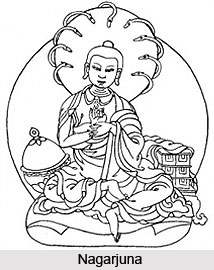
 Sunyata or emptiness is considered as one of the major teachings of Nagarjuna which bring together anatman and pratityasamutpada. He had discovered the records of Buddha`s secret sermon called Prajna Paramita. Prajna Paramita is not ordinary wisdom as it goes beyond the original teaching which is the four truths and the law of Causation. It does not reject the original reaching which is the Second Turning of the Wheel of Law that is a consequence to the First Turning of the Wheel.
He had developed the negativist doctrine of Prajna Paramita. He created a dialectic which avoided extremes of confirmation and refusal thereby being called Madhyamika. Nagarjuna did not categorically define the pursuit of ultimate reality. The existence of an object by itself is absurd and it is superfluous to describe the object as real or not. One cannot dispute the interdependence between the different points of the chain. The points are conditional yet inevitable. Therefore it is believed that one who realizes Pratityasamutpada realizes the Four Truths. This is attained in the second stage of sadhana where wisdom is the means. The eight fold path is the medium in the first stage.
One can reach the stage of wisdom after the stage of ethics and meditation. He adhered to the validity of conduct. According to Nagarjuna all phenomena have no svabhava or "self-nature" thereby without any primary essence. All things arise dependently not by their own power but by depending on conditions that lead to their coming into existence. He was also instrumental in the development of the two-truth doctrine. This is a principle where it says that there are two levels of truth in Buddhist teaching, one is directly true and the other that is conventionally true also known as upaya in later Mahayana writings.
Nagarjuna was inspired by an early version of the doctrine found in the Kaccayanagotta Sutta that differentiates clear and obscure terms. Nagarjuna differentiates between traditionally true and ultimately true teachings. However he never declares any clearly defined doctrines.
The idea of relativity has been taught by him. For instance in Ratnavali, he says that shortness exists in relation to the idea of length. The determination of a thing is only possible in relation to other things. The relationship between "short" and "long" is not due to its intrinsic nature.