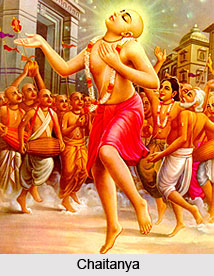
 The essence of teachings of Chaitanya lies in the eight verses called Siksastakam. He explained the relation of God to the world and souls in terms of bheda and abheda, difference and non-difference, or oneness. "Difference" is the acceptance of a real material world, several real souls and a God who has perfect qualities. "Oneness" is the acceptance of existence of one supreme entity, with no differentiation of form, qualities and souls. According to Chaitanya Mahaprabhu mutual contradictions can coexist through the inconceivable power of God. Therefore his world view is known as achintya-bheda-abheda and difference joined by the unimaginable power of God. One believes in their own individual existence if they accept difference. Only with difference there can be a relationship between the soul and God. Through oneness the distance becomes meaningless.
He taught this philosophy through the chanting of the holy name of the Lord. He taught that the holy name of the Lord is the sound incarnation of the Lord. Chanting the holy name of the Lord one can directly associate them with the Supreme Lord by sound vibration.
According to him a pure devotee is a soul who is forever surrendered to the Lord. In the surrendering process, one should: (1) accept things that are favourable for discharging devotional service, (2) reject things that are unfavourable, (3) believes firmly in the Lord`s protection, (4) feel dependent on Lord`s mercy (5) have no interest other than interest of the Lord and (6) always feel humble.
Lord Chaitanya teaches direct worship of Lord Krishna. He also suggests that the place known as Vrindavan is as good as Lord Krishna. He also recommended that the highest mode of worship in the highest is the method practiced by the damsels of Vraja. The cowherd girls simply love Krishna without any motives.
His teachings are identical to those given by Lord Kapila. One should not meditate on something void. One can meditate on the transcendental form of Lord Vishnu which is called samadhi. He taught the philosophy of Achintya bhedabheda through the chanting of the holy name of the Lord.
He teaches the science of Krishna consciousness which is absolute. One has to engage his mind and senses in Krishna conscious activities and Chaitanya teaches one how to do this in practice. He is the ideal teacher of life`s prime necessities. He is the most bountiful bestower of love of Krishna.