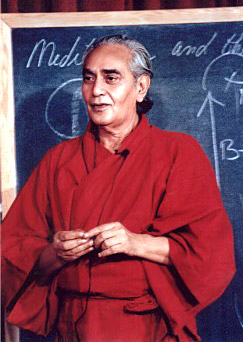
 Swami Rama was born in a northern Indian Brahmin family and was a descendent of the Himalayan masters who held Sankya Yoga tradition. His birth name was Brij Kishore Dhasmana. His master or Guru was Bangali Baba, under whom he was raised in Himalayas. He traveled in various monasteries and studied under many Himalayan saints and sages, including his grandmaster who was living in the remote region of Tibet. From 1949 to 1952 Swami Rama held the prestigious position of Shankaracharya of Kavirpitham in South India. After that he returned to Bengali Baba in 1952 and spent many years in further practice in the Himalayan caves. Swami Rama was encouraged by his teachers to go abroad, specifically in the United States, where he could spend his life in teaching the ordinary people.
Swami Rama was notable as the first Yogi who allowed him to be studied by western scientists. In the 1960s the scientists from Menninger clinic studied his ability to voluntarily control bodily processes such as heartbeat, blood pressure, body temperatures etc., which are normally thought to be involuntary or autonomic.
Swami Rama was the founder of the Himalayan institute of Yoga Science and Philosophy, whose headquarter is situated at Honesdale, Pennsylvania, USA. There are many other branches in the USA, Europe and India. Swami Rama was also the founder of other teaching and service organization.
Swami Rama wrote several popular books during his lifetime. In these books he described the path he took to become a Yogi and laid out the philosophy and benefits behind the practices of meditation. The common themes explained in these books are `enlightenment without God` and `living with the Himalayan Masters`. Swami Rama criticized the tendency of the yogi to use supernatural feats to express their power. He argued that this only demonstrate the ability to perform a feat.