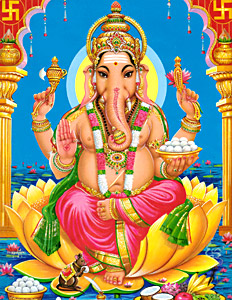
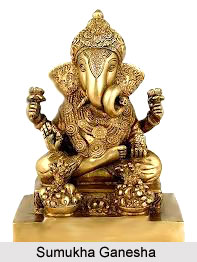
 Sumukha is one of the twelve Forms of Lord Ganesha, the others being Ekadanta, Kapila, Gajakarnaka, Lambodara, Vikata, Vighnanasa, Vinayaka, Dhumraketu, Ganadhyaksa, Bhalachandra and Gajanana. The 12 names or forms of Lord Ganesha are recited for the successful and positive completion of any new project and venture. Ganesha is widely worshipped through out the country by Hindus, Buddhists and Jains. Ganesha is the Lord of Beginnings, the Remover of Obstacles and the Patron of Letters, Arts and Sciences. The Sumukha form of Lord Ganesha refers to the one who has a beautiful face. The divine beauty of his parents, Lord Shiva and Goddess Parvati, his parents is reflected through the elephant faced god, who has a single tusk and small eyes.
Legends of Sumukha
According to various legends mentioned in the ancient Hindu Puranas, during his childhood, Lord Ganesha was hit several times by the holy trident and other weapons of Lord Shiva. As a result of this, the body of Bala Ganesha became radiant and incandescent like the sun. The deity became round in shape and entered the perimeter of the moon, known as Chandra Mandala. The moon or Chandra Deva is considered as the God of Beauty. Thus after Lord Ganesha entered the Chandra Mandala, the radiant segment of the lord again regained life. Lord Ganesha was bestowed all the major traits of the moon. Thus he was given the name Sumukha.
It is also mentioned that Lord Ganesha was transplanted with the head of an elephant and had a single tusk and small eyes. The appearance of the deity might not be considered beautiful. But as the lord was the son of Lord Shiva and Goddess Uma (Parvati), Ganesha conveyed their divine nature within him and also reflected the divine beauty of both his parents. The long trunk of the deity signifies intellect and wisdom; his small eyes denote seriousness; and his long flat ears represents his knowledge and ability of extreme nature. Ganesha listens to all the prayers and grievances of his worshippers.
He enunciates the combined nature of Omkara, which represents Lord Bramha, Lord Vishnu and Lord Shiva. All these dimensions have given Ganesha the name Sumukha.