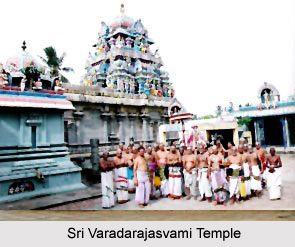
 Sri Varadarajasvami Temple is one of the significant temples in the small village of Poondamallee. Many areas near Chennai are birth-places (venerated as the avatara-sthalas) of the renowned Srivaishnava Azhvars and Acharyas like Tirumazhisai (remembered as the birth-place of Tirumazhisai Azhvar).In Poondamallee, Pushpapuri Kshetram, is a sanctified place where is erected a beautiful temple for Sri Varadaraja Perumal. It is situated near the main market and bus-terminus. Devotees visiting this temple can have darshan of Lord Varadaraja, Lord Ranganatha and Lord Srinivasa, all enshrined in separate sanctums inside the large enclosure of the same temple-complex of Sri Varadarajasvami.
Sri Varadarajasvami Temple is famous as a legendary and antique temple dedicated to Lord Varadaraja Perumal. However the legendary stories associated with this temple endowed it with a dignified majesty. The temple has its entrance via a large pillared mandapa which leads to the principal sanctum enshrining Lord Varadaraja facing east. According to the Sthala-Purana (temple-legend) and other legendary stories Lord Varadaraja gave darshan to Sri Tirukkacchi Nambi, His ardent devotee during sunrise and hence the main image or moolavar is made with a structure representing Surya Prabha around His head. The deity here is seen with four-hands, holding the conch (sankha) and discus (chakra) in His upper hands with the lower right hand in the posture of abhaya hasta. This gesture representing protection offered by Him to His followers and lower left hand in made in the posture of kati hasta (resting on His thigh) and flanked by Sri Devi and Bhu Devi. The imposing image of Lord Varadaraja Perumal is made up following the legendary story associated with the temple. The vimana under which the deity is enshrined is known as Punyakoti Vimana just like the one in the Sri Varadarajasvami temple, Kanchipuram. The name of the temple conforms to the legendary story as described in the Sthala Purana of this place. In a row in front of this shrine are the stone and bronze images of the twelve Azhvars. Thus the legends provide a splendid dignity to this antique temple situated in Poondamallee.
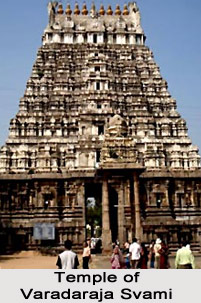 The legendary temple, with the Pallava style of architecture is provided with an exceptional dignity by the epigraphs imprinted on the walls. There are four ancient inscriptions found in this temple, the earliest of which dating back to the 13th century A.D. Three of these ancient inscriptions are written in the Tamil language and in the ancient Tamil script while one is in Sanskrit written in the Grantha script. Only one of these three epigraphs contains the date of the inscription, while the others are undated. As the historians have opined the inscription throws light on the donations made to this ancient shrine. The first of these is etched on the south base of this temple. As the researches point out this inscription is dated 1274 A.D. and belongs to the reign of a chieftain named Vijaya Gandagopala of the Telugu Chola dynasty. The inscription records the gift of a cow for maintaining a lamp by a native of Semmambakkam. The next inscription which is unfortunately incomplete belongs to the time of king Jatavarman. The king is also known as Vikrama Pandya Deva belonging to the dynasty of the imperial Pandyas of Madurai and registers the gift of land to this temple. Another epigraph in the same place records the donation of a village known as Chera Pandya-chaturvedimangalam to the administrative assembly (Sabha) of this village. The last inscription is the only one which is inscribed in Sanskrit, mentions that a Chera king granted the village of Chera Pandya-chaturvedimangalam for the enjoyment of Brahmin priests. The name chaturvedimangalam indicates that it was a place inhabited by Brahmin scholars well-versed in the Vedas and other ancient scriptures and literary texts.
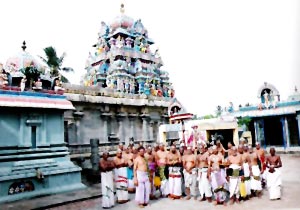 In the occasion of Vaikasi (May-June) is observed the festival of Varadaraja Brahmotsavam; in the occasion of Ani (June-July), the festival of Satakalasa Tirumanjanam is celebrated; Adi Puram is the grand festival celebrated in the month of Adi (July-August); Navaratri, Pavitrotsavam is organized for three days and Srinivasa Utsavam for ten days are celebrated in Purattasi (September-October); Manavala Mamuni Avatara Utsavam is held in Aippasi (October-November); Tirukkartigai is observed in the month of Karttigai (November-December); Tiruadhyayana Utsavam is organized in Margazhi (December-January); the grand festival of Tirukkacchi Nambi Avatara Utsavam is celebrated for ten days in Masi (February-March) since Masi Mrigasirsham is the birth asterism of this great Acharya; in Panguni (March-April) is celebrated in a grand style, the Dhavana Utsavam and Panguni Uttiram when the Tirukalyanam of Lord Varadaraja and Pushpavalli Thayar is celebrated and also the Mangalasasanam Utsavam when the three Garuda sevas for Lord Varadaraja, Lord Ranganatha and Lord Srinivasa are celebrated. All these festivals are celebrated with great magnificence and splendor.