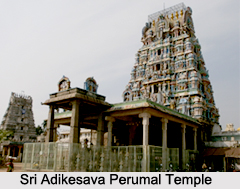
 The tiny but ancient village of Kuram is situated about ten kilometers interior from the city of Kanchipuram. The small village of Kuram has been famous through the ages as it is the home to the famous temple dedicated to Lord Adikesava Perumal and as the birthplace of Kurattazhvan or Kuresha (1008-1127 A.D.), which was born in the asterism (nakshatram) Hastam in the Tamil month of Thai. Later became the famous disciple of the renowned Srivaishnava preceptor Sri Ramanujacharya.
The temple dedicated to Lord Adikesava, facing to the eastward direction, is a small shrine. But the antiquity of this famous temple is revealed from the inscription stamped on the wall of the temple. The epigraphic evidences mention that this traditional shrine was in existence as early as the 9th century A.D. when the kings of the Pallava dynasty were ruling supreme in north Tamil Nadu. Under the patronage of the Pallavas the Lord Adikesava was in active worship, which was continued in the subsequent periods as well. The beautiful stone icon (moolavar)of the lord is the chief attraction of the temple. He is seen in a standing (sthanaka) posture with four arms (Chaturbhuja). He is seen here flanked by the deities like Sri Devi and Bhu Devi by His side. To the left of the main icon or the moolavar is erected a figure of lord Ananta or Adisesha. The beautiful utsava murtis are equally fascinating. These images of the Kuram temple are very similar to the main ones and beside them is seen an exquisite bronze image of Lord Krishna in a dancing pose. The arrangement of the deities in the pedestal and the moolavar and the utsava murtis collective cast a fascinating sight, which enraged the sense of veneration in the minds of the devotees.
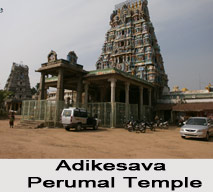 The legendary temple of Sri Adikesava Perumal in Kuram is built during the period of the Pallavas. Hence the architectural style, which adorn the entire shrine reflect the essence of the Pallava art. The sanctum for Goddess Lakshmi, enshrined in this temple-complex is referred to as Pankajavalli Thayar. The beautiful shrine dedicated to the goddess Pankajavalli Thayar is east facing and is situated to the right of the principal sanctum. To the left is erected a shrine dedicated to Sri Andal. The images of the deities bear the evidence of the exquisite Pallava art. The image of goddess Pankajavalli Thayar is unique as She is seen holding a lotus in Her left hand while in all other temples she is depicted as holding this flower in her right hand. This image of the goddess also points to the exceptional ideas of the Pallava architects.
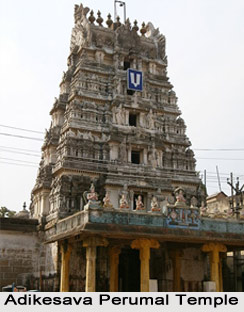 The inscriptions engraved on the temple walls reveal the chronological significance of the temple and provide other valuable information closely connected with the temple. Moreover the inscriptions engraved on the temple walls lend it a majestic grandeur and stately disposal. The oldest inscription found in the Sri Adikesava Perumal temple, dated 808 A.D. is one of the ancient epigraphs found on this temple. It seen on the south wall and belongs to the reign of the Pallava king Dantivarman. There are also many other inscriptions, which belong to the Pallava age of the 9th century A.D. The inscriptions depict the royal orders, which throw light on the functioning of the administrative organization called Sabha in the village. One of the most important inscriptions found in this village is a set of seven inscribed copper-plates of the 7th century A.D., the first portion of which is composed in Sanskrit particularly the Grantha script and the second portion is composed in the language of Tamil.