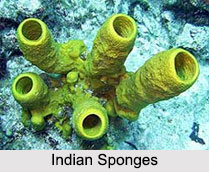
 Indian Sponges are the lowest of the slimy and multi-cellular animals. Their tissues are primitive and not differentiated as in other multi-cellular animals (metazoa). They are therefore placed under an isolated division namely, Parazoa. All sponges, except a single freshwater family live in the sea attached to rocks, pilings, plants, etc. They grow much as plants do. Some are branched and some are shaped like cups, gloves and domes. In size, sponges range from one millimeter to a meter in diameter and 40 centimeters in thickness. Despite variation, their essential structure is the same.
Physical Structure of Sponges
The physical structure of a typical simple sponge is that of a vase or cylinder, closed and fixed at one end. There is an opening called the osculum at the free end. The cylinder encloses a cavity - the gastric cavity or paragaster. The wall of the cavity has two layers - an outer layer of flat cells and an inner lining layer of collared cells (cells with cilia or flagella). The cells in both these layers are loosely connected and not fitted firmly as in other multi-cellular animals.
Sponges are grouped according to their skeletal peculiarities. All sponges have a gelatinous layer of mesoglea between the two layers of cells. Embedded in this mesoglea is a skeletal framework. The skeleton consists of lime (calcareous), glass (siliceous) needles or spicules or horny fibre sponging. Calcareous spicules are generally single, three or four-layered. The siliceous spicules are much more varied in shape and in the same kind of sponge there may be different forms of spicules, each form having a special place in the skeleton of the various parts of sponge body. Sponging is a substance closely allied to silk. In the common bath sponge, the skeleton is entirely made up of sponging threads, which branch and form a compact and an extensive supporting structure. The skeleton is not only supportive but also protective. The sharp spicules and the bitter taste of sponging keep predacious enemies off.
Digestive and Excretory System of Sponges
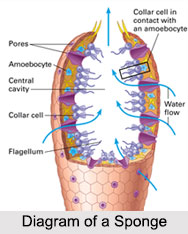 Sponges feed on living or dead minute organic particles present in the surrounding water. These particles circulate in the body of the sponges through a canal system which falls under three types. On the outside of a sponge are a number of minute pores. Leucosolenia, a common seashore species attached to rocks is recognized as a simple sponge. In this sponge, the pores open directly into the gastric cavity. Water enters into the cavity through the pores. The collared cells lining the cavity digest the food matter contained in water and throw out the waste. The refuse water is finally pushed out through the osculum. The inflow of the water through the pores, its circulation within the cavity and its final ejection through the osculum are all due to the harmonious lashing of the vibratile cilia of the collared cells in the direction of the osculum. This simple canal system is called `ascon`. In the next higher type of sponges, which exists in the genus known by the name Sycon, the wall of the cavity is folded into a series of flagellated chambers. Outside water enters these chambers through special in-current canals connecting the pores and the chambers. Digestion takes place in the chambers. The used water then flows into the cavity and thence out, through the osculum. In the third type, `leucon` or rhagon, the flagellated chambers become further folded into a number of smaller chambers each one connected to the pore by an incurrent canal and the gastric cavity by an excurrent canal. This elaborate system is found in all fibrous (bath and freshwater) sponges.
Reproduction in Sponges
Sponges reproduce asexually by budding or sexually by ova and sperms which unite to form a zygote. The zygote divides and becomes a spherical mass of cells successively called the blastula and the amphiblastula. Later it invaginates (or tucks), develops collared cells within, fixes itself to a holdfast and grows into an adult.
In the cavities of large-sized sponges, small shrimps, sea worms and molluscs enter and live for shelter and feed on the waste matter. The sponge is inedible and with it as a cover, the molluscs and crabs are protected from their enemies. The sponge is benefited by it being carried from place to place, enabling it to obtain adequate oxygen and food.