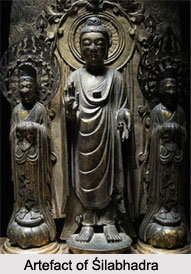
 Shilabhadra was a Buddhist monk and philosopher in ancient India, who was popularly known as the teacher of Hiuen Tsang. He is best known as being a teacher of Nalanda University and monastery in early India.
Early Life of Shilabhadra
Shilabhadra was born in the Samata kingdom, in the Brahmin caste, to the royal family there. Shilabhadra went westward to Nalanda, and was trained there by Dharmapala of Nalanda, who also ordained him as a Buddhist monk. According to the historical account of Hiuen Tsang, Shilabhadra gradually became famous for his learning even in foreign countries. At 30 years old, after defeating a Brahmin from southern India in a religious debate, the king insisted on giving him the revenue of a city, which Shilabhadra accepted with reluctance, and he built a monastery there and kept it funded with the city`s revenues. The name of this monastery was Shilabhadra Vihara.
Teaching Career of Shilabhadra
At the age of 33, the Chinese traveller, Hiuen Tsang made his journey to India in order to study Buddhism there and to procure Buddhist texts for translation into Chinese. Hiuen Tsang spent over ten years in India travelling and studying under various Buddhist masters. These masters included Shilabhadra who was then 106 years old. Shilabhadra divided the Buddhist teachings into three turnings of the Dharma Wheel. In the first turning, the Gautama Buddha taught the Four Noble Truths at Varanasi for those in the Sravaka vehicle. It is described as marvellous and wonderful, but requiring interpretation and occasioning controversy. The doctrines of the first turning are exemplified in the Dharmacakra Pravartana Sutra. This turning represents the earliest phase of the Buddhist teachings and the earliest period in the history of Buddhism. In the second turning, Buddha taught the Mahayana teachings to the Bodhisattvas, teaching that all phenomena have no-essence, no arising, no passing away, are originally quiescent, and essentially in cessation. In the third turning, Gautama Buddha taught similar teachings to the second turning.
Books by Shilabhadra
Silabhadra composed the text Buddhabhumivyakhyana, which is now extant only in the Tibetan language in the modern world of Buddhism.