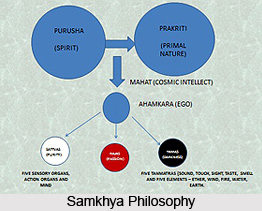
 Brhadaranyaka Upanishad is one of the important parts of Upanishad. It relates about the Purush Sukta of the Vedas. It contains symbolism, metaphors and imagery for describing the nature of reality. The second chapter of part one of Brihadaranyaka Upanishad discusses the process of creation. It states about the relationship between the absolute and the universal being as well as about the cause and effect relation. It says that nothing was here before as everything remained enveloped by death.
Initially, nothing existed. Death and hunger enveloped everything. He then moved from one place to another, worshipping Himself. By worshipping water was produced also known as arka. Hiranyagarbha became tired after creating the earth. As he was exhausted and heated brightness originated from him. That was fire. He then divided Himself into three: the sun, one-third and the air one-third. Thus, prana is also divided into three. His head is the east and His arms are the north-east and south-east. His hinder part is the west and His two hip bones are north-west and south-west. The north and south are his sides. The heaven is his back while the intermediate region is his belly. The earth is believed to be his chest. He is thus, placed firmly on water. One who is aware of this is able to stand firm everywhere he goes. Now, he wanted his second self to be born. Death led to the union of speech with the mind and bore him for a year and later time projected him. He opened His mouth to consume him when he was born. He then immediately said `Bhan` and that became speech.
Through the union of speech and mind He created the Rig Veda, the Yajur Veda, the Sama Veda, the sacrifices, the metres, animals and men. He wanted to eat everything He produced hence Death is known as Aditi. He wanted to sacrifice again but grew tired because of austerities. The pranas when moved out of His body he began to swell. However, the mind remained set on the body. He then thought of sacrificing his body. Hence he penetrated into the body. As the body swelled (asvat) it came to be known as horse (asva) and because it became fit for sacrifice (medhya), the horse sacrifice came to be known as Asvamedha Yajnya.