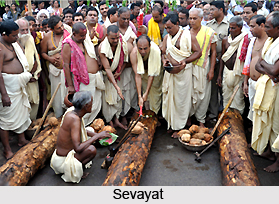
 Sebakas are those who perform the ritual services in the Jaganath Temple of Puri. The sebakas who are present in the temple generally acquire their position by means of hereditary. In the 13th century AD and during the British period it was recorded that there are 36 categories of sebaka but presently the account says that there are around 250 categories of sebakas who perform the daily ritual services in the temple of Jagannath. The first sebaka or the sevayat of Lord Jagannath was Gajapati, the ruler of Puri.
The sebakas are very closely associated to the Jaganath Temple of Puri. The sebakas have a very different life style. Historical record says that during the time of the independent kings the sebakas used to be paid in gold for the services they performed in the temple. Later on, the payment in gold changed to payment in consecrated food. The dues of foodstuff that a sebaka was entitled to get for his service in the temple are called Khei. The sebakas lead a kind of life that was in conformity to their belief system and the public image. The family and the society of the sebakas are the basic institutions serving to check any deviation from their traditional thought-ways and work-ways.
With regard to the dressing patterns of the sebakas it can be said that in like the early days different types of cloth produced at different places of Orissa were used for the dress (besa) of the deities, the Sebakas also use hand woven cloth of special types produced in Ranpur and Bolgarh. But with time a lot of changes have come about in the dressing pattern of the sebakas of the Jaganath Temple of Puri. For instance it can be said that towards the end of the British period the sebakas used to shave their hair in the front portion of the head and keep the hair intact at the back. This type of hair dressing is called Gospada. Similarly in the early day`s mill made cloth was prohibited for the sebakas but in the present age mill made cloth has become very popular in the present age.
The sebakas of the Jaganath Temple of Puri use different type of forehead marks indicating that they belong to different sects. In the past, invariably all sebakas used to mark one type of tilak which is called Udhra Punda. Later some of them added another mark called Tripunda along with Udhra Punda. Those who used Tripunda generally belonged to the Panda group of sebakas. Subsequently certain sebakas groups such as Mahanayak, Bhitarchha Mahapatra and Sinhari were influenced by the Sri Sect and adopted the mink of that sect.
As far as the education of the sebakas is concerned it is said that before joining the service in the temple the sebakas, particularly the Puja panda sebakas, used to undergo training at the Gobardhan Bhogbardhan Math in the methods of Seba Puja. The sebakas of other categories used to receive training in Sanskrit knowledge and doctrines of the Jagannath cult from the Sanskrit pandits of Puri. But unfortunately during the British regime the traditional educational institutions imparting instructions in Sanskrit knowledge scriptures, and religious doctrines started declining and the organizations established by the Sanskrit scholars began to be disintegrated. As a result, many sebakas of the Jaganath temple could not receive any training in the methods of ritual services and gather necessary knowledge about the Jagannath cult.
It can be said about the sebakas that traditionality in dress and ornament, food habits and social relationship is the special feature of their social life. The sebakas live in different wards or streets of Puri town which run in different directions from the temple of Lord Jagannath. The sebakas of the temple are very averse to anything that is western. Even they do not use western medicine and so does not have faith in allopathy and on the contrary rely on ayurveda for the curing of all their diseases.
The sebakas of the Jaganath Temple of Puri consider Puri as the holiest place of pilgrimage and therefore rarely visit other pilgrim centres located in other parts of the country. They consider Indradyumna Tank as the foremost place of pilgrimage, because it was Indradyumna who built the temple in Puri and had got it sanctified by Lord Brahma and had installed Lord Jagannath in it.
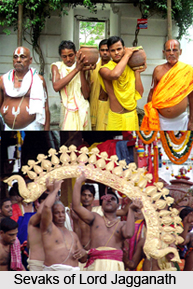 The sebakas who serve the Jagannath Temple of Puri have been categorized based on their nature of appointment and importance of their services. Different sebakas have assumed different status in the constellation of ritual services. The various categories of sebakas are Swata Sebayat, Mahashrama Nijoga, Kotta Sebayat, Khatani Sebayat, Parajatra Sebayat and the Khatanihara Sebayats.
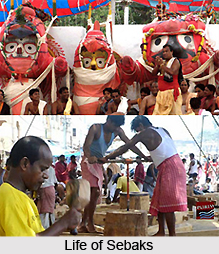 Social life of the sebakas is quite traditional. The sebakas of the Jagannath Temple of Puri live close to the temple in large concentration. In fact, the streets occupied by the sebakas start from the temple occupying the central place in the sacred geography of Puri and then run in different directions. The houses are constructed on elevated platforms made of stone and are in most cases without windows. Small opening are provided in the walls which let some light into the rooms.