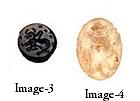
 This Greenish-grey chalcedony is seen engraved with a griffin and was found in the northwest of Indiansubcontinent. The seal has longitudinal piercing parallel to the body of the griffin. It is domed, with chamfered sides, and was probably set on a swivel in a pendant or a ring. A griffin is a mythical animal of Greek and Roman art, usually depicted with a lion`s legs and body, wings, and an eagle`s head. Here the wings, head and tail are those of a griffin, but the body and legs are those of a horse. The rounded forms of the body belong to Iranian tradition.
Along with this seal another seal shows Sardonyx, depicting Hariti and it is found in the northwest Indiansubcontinent. While not cut to the highest standard, this seal is an excellent example of a western classical style and technique adapting itself to Indiancostume and iconography. This goddess is probably Hariti, wearing obviously Indiandress. The cornucopia she holds in her left hand shows no understanding of its Greek or Roman model; the sword in her right hand is not one of Hariti`s attributes and suggests that the seal was produced in the same Indo-Iranian religious climate that produced the divinities on the reverse of Kushana coins.
This Bloodstone is engraved with a sitting bull and it is found in the northwest of Indiansubcontinent. This seal consists of three-quarters of a sphere and is pierced through the centre. The bull is the humped Indianbull (Bos indicus). The rounded forms, attest to Iranian tradition, here reinforced by the shape of the seal, which is typical of Iranian examples.
The other Crystal shows Hercules subduing the Nemean lion and was found in the northwest of Indiansubcontinent and it can be traced back to the Gupta period. This fine seal, displays a technique, done in a western classical style, but also suggests an eastern origin.
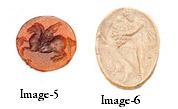 One of the twelve labours of Hercules, his combat with the Nemean lion has been depicted innumerable times in Hellenistic and Roman sculpture. But the iconographic formula of Hercules holding the upright lion in a stranglehold around the neck is quite different from the combat depicted here. The seal has a Gupta-period inscription.
This Carnelian is engraved with a winged horse North-west of Indiansubcontinent, but possibly an import from the West and this seal is flat on front and back. It is of extremely fine workmanship, and from its technique might be the work of a Greek engraver. While the flying horse strikes a familiar note as Pegasus, representations of the winged horse are not common on Greek and Roman seals.