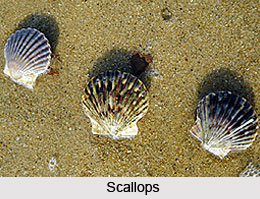
 Scallops are bivalve molluscs with handsome shells which are almost round and flat and neatly ribbed. At the upper edge they carry an ear or semicircular lobe on both sides. The surface is invariably designed with bright colours. The animal within the shell is more interesting than the shell itself. When young, Scallops fix themselves to a rock or other solid object but in the adult stage they become free and move throughout the water in a zigzag course by rapidly opening and closing their valves. For this sort of swimming movement a foot is not necessary and it therefore becomes atrophied through disuse. Another unique feature of a scallop is that it has highly developed eyes borne on the tips of the short tentacles which hang down as a sort of fringe from the edge of the mantle. These eyes, iridescent and green in colour, are almost as complex as the eyes of higher animals, having a retina, cornea and lens.
Scallops generally prefer shallow waters where small seaweeds grow in plenty. Many large and attractive species of scallops abound along the Atlantic shores and there are a few handsome representatives here such as Pecten tranquebaricus, P. senatorius and P. splendidulus. They are all medium-sized measuring from four to seven centimetres in height, triangular oval or round in shape, strongly ribbed radially, with prominent ears at the umbo and with various colour mottles or markings. These scallops are common along the western and eastern coasts of India and in the Pamban area.
In the deeper waters of the Bay of Bengal, off the Ganjam and Orissa coast, exist an exceedingly elegant scallop - Amussium pleuronectes, which is round, smooth, polished and painted red. It is known as the `sun and moon shell` because its upper valve is of a livid hue and the lower one a dead white. This scallop often gets entangled in fish-nets. Young ones and adults are found in large numbers from the month of March to June every year. A fully grown specimen measures 8.3 centimetres in diameter. Along the edge of its mantle there are numerous eyes - as many as one hundred - of different sizes, round and staring like those of a doll. Amussium is a very active scallop. A living animal placed in a basin of sea water may be seen darting about with amazing quickness.