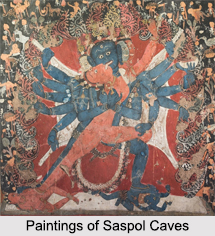
 The Saspol Caves in Jammu and Kashmir contains astonishing rock-cut temples of the Buddhist religion that dates back to the 13th - 15th century AD. There are astounding sculptures and figurines from the Tibetan culture of the medieval era. Most of the appealing monuments are situated in the Indus valley, Saspol village. The beautiful rock-cut temples of Saspol Caves are in the vicinity of the village itself. Around 4 of the caves are beautifully decorated with paintings, in bright colour, of Buddhist pantheon. It depicts a merger of the Tibetan and Indian Buddhist art.
Interior and features of Saspol Caves
On the top of these rock-cut temples, there are residues of an earliest fort. Interior of these caves is very simple. The ceiling for most of the part has been left with no changes, with large rocks balanced in corporation. Although, the walls are plastered with clay and covered with bright coloured paintings, the paintings consist of a big amount of smaller miniatures showing numerous deities of Buddhist pantheon.
The Cave 2 is painted with orange colour. The Paintings of the Cave 1 are faded and Cave 3 is the higher part of two-storied cave. Cave 4 is situated at a maximum height than the others. The caves have been shaped in the 13th to 15th century AD by the followers of Tibetan Buddhist School Drikung Kagyu. This school of Buddhism is famous in Ladakh up to this day while in Tibet, it has been returned by other schools long ago. There are some miniatures showing Hevajra - one of ishta-devas and Samvara, guardian deities are the attractive feature of paintings. These are two similar ancestries in awareness of this deity.
Caves have been created by proponents of Drikung Kagyu, Tibetan Buddhist School. The main concentration was on the meditative practices. The fascinating trait of these paintings are the miniatures that portray Hevajra, an Ishta Deva, a state of enlightenment which is achieved at the final stage of meditation. They also depict the guardian angel, Samvara. In some images, the deities are two-handed, while in others, they appear as twelve- handed. This portrayal of the deities signifies the fusion of the Tibetan and Indian customs. There are other monuments in the surrounding areas of Saspol village which are steeped in history.
Visiting information of Saspol Caves
To arrive at the caves one must take the unpaved road north of the NH1 at Kilometre 371.1, then after move 800 metres to walk up the meandering path.