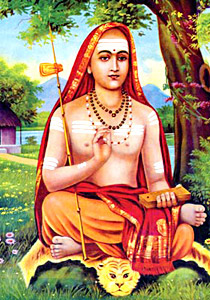
 In the Hindu mythology, Sankara Acharya is regarded as the great Saiva Reformer, who flourished, in the eighth or ninth century.
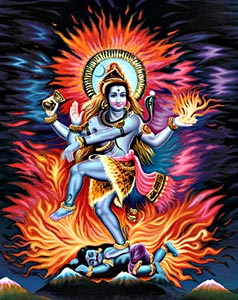
Sankara Acharya was a distinguished professor of the Vedanta and Advaita system. He was a native of Kerala, Malabar, of the tribe of Namburi Brahmans, and in the mythological language of the sect an incarnation of Shiva.
In Malabar, Sankara Acharya is said to have divided the four original tribes into seventy-two, or eighteen sub-divisions each, and assigned them their respective rites and duties.
In a legendary story it is said that once when Sankara Acharya returned home, on one occasion, his mother died, and he had to perform the funeral rites. For the last rites of his mother, his relations refused to supply him with fire, and at which all the Brahmans declined to assist. Sankara then produced fire from his arm and burnt the corpse in the courtyard of the house. Sankara Acharya infuriated, denounced that the Brahmans living there should not study the Vedas and that the religious mendicants should never obtain alms. He also made rules that the dead should always be burnt close to the houses in which they had resided.
All accounts corresponds in representing Sankara as leading an erratic life, and engaging in success controversy with various sects whether Saiva, or Vaishnava, or of less orthodox opinions as the Buddhists and Jains. In the course of his peregrinations, he established several `Maths`, or convents, under the presidencies of his disciples, particularly one, still flourishing at Sringeri, or Sringiri, on the Western Ghats, near the sources of the Tungabadra. Towards the dose of his life, Sankara Acharya repaired as far as Kashmir, and seated himself, after triumphing over various opponents, on the throne of Sarasvati. He next went to Badarikasrama, and finally to Kedarnath, in the Himalaya, where he died at the early age of thirty-two. The events of Sankara Acharya`s last days are confirmed by local traditions, and the Pitha, or throne of Saraswati, on which Sankara sat, is still shown in Kashmir. While at the temple of Shiva at Badari, a Malabar Brahman, of the Namburi tribe, has always been the officiating priest.
The influence exercised by Sankara in person, has been perpetuated by his writings, the most eminent of which are his Bhashyas, or commentaries on the Sutras or Aphorisms of Vyasa. A statement on the Bhagavata Gita is also ascribed to Sankara Acharya, as is one on the Nnsinha Tapaniya Upanishad, and a cento of verses in praise of Durga.