After marriage, when the bride is brought to her new home, she is made to sit by a mound of salt. Then her husband`s relatives plunge their hands into the salt with her and `measure the salt`. This is called `dattar mavan` and is done to ensure future harmony between the bride and her new relatives. When married, she is given a nose ring set with two pearls and a ruby by her husband as a symbol of her new status and her mother gives her ivory bangles.
This jewellery is taken away and the bangles broken if she becomes a widow. In the olden days a widow had to sleep on the floor for 12 months, wear a red gharara (skirt) given by her mother and could not leave the four walls of the house but nowadays these restrictions are seldom imposed.
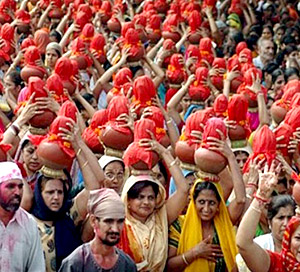 Chedchand, a typical Sindhi festival, falls at the end of Phalguna and heralds the new year which commences with the month of Chaitra. It can also be seen as the usual spring festival that is celebrated in India. On this occasion the Sindhis worship water. For them it symbolises the `Darya Shah`, the river Sindhu. They put water in a large thali or vessel and make a diya (lamp) of `atta` (flour) and light four wicks in it. After performing puja, sweets are distributed as `prasad.` Amidst dancing, singing and glee, the lamp and the `prasad` are immersed in the water.
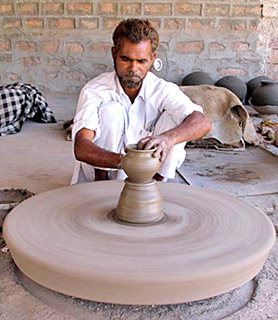
Another Sindhi ritual is handa. While rice cooks in an earthenware pot on an open fire, Brahmins chant special mantras and perform puja. At the end of the puja the mouth of the pot, tied with a piece of cloth, is opened. It has been observed that when uncovered, the handa splits into four equal parts.
Their everyday food, which is simple and requires little preparation, is generally `khichri` (made of rice and dal) vegetables, curds, and others. On special occasions they eat special food, such as pulao, malpua and meat. They eat fish and all kinds of meat except beef.
In spite of all their flamboyance, their fondness for wealth and its trappings their taste is essentially simple. This is evident in their choice in matters of clothing, jewellery and food.
To put it in a gist the Sindhis are exuberant, lavish and resilient and are the backbone of the country`s middle-class economy.