 Ratnavali or The Neck-Lace is the title of a Sanskrit Drama. The play is based on the life of a beautiful princess Ratnavali and the great King Udayana.
Ratnavali is the play and is a continuation to the story of Princess Vasavdatta of Ujjaini and King Udayana of Kaushambi. Vasavdatta because of certain consequences had to fake her death.
To keep the relation steady between the two countries Ujjaini and Kaushambi, Vasavdatta`s cousin sister Ratnavali was sent to be married to Udayana. In the interim, Vasavdatta`s faked death was a success and she had returned, reuniting with Udayana and retrieving her position as Queen of Kaushambi.
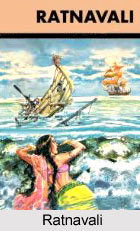
Ratnavali was uninformed of this situation. When she was coming to Kaushambi, her ship was wrecked and she was cast adrift until a merchant ship found her and took her to the palace. In the palace she was disguised as a commoner or servant in the name of Sagarika. Vasavdatta assigned her as a Lady-in-waiting and gave her duty to the care of Medhavini, the myna bird.
Vasavdatta was afraid that Udayana would be persuaded by Ratnavali`s beauty. So Vasavdatta took steps to hide Ratnavali or Sagarika from her husband.
There was a festival in the state and Sagarika stayed back home to do her duty. Later she was offered by a companion of the queen Susangata to watch Medhavini in her stead. When Sagarika reached the festival and saw Udayana, she fell in love with him, but was sent home due to Vasavdatta`s envy. Through a series of unlikely events, Susangata and Sagarika plotted to unite the king and Sagarika. In the end, Sagarika marries Udayana as his third wife.
Ratnavali, the drama marks a change in the principles of dramatic composition, as well as in those of social organization. Besides the want of passion, and the substitution of intrigue, there is in it no poetic spirit, no gleam of inspiration. The only poetry of the play is in fact mechanical. The structure of the original language is eminently elegant, particularly in the Sanskrit. This dialect appears to equal advantage in no other drama; the Sanskrit style is also very smooth and beautiful, without being painfully elaborate. The play is indeed especially interesting in this account, that whilst both in thought and expression there is little fire or genius, a generally correct and delicate taste regulates the composition, and avoids those absurdities which writers of more pretension than judgment, the writers of more recent periods, invariably commit. The play must have been written between 1113 and 1125 A.D.