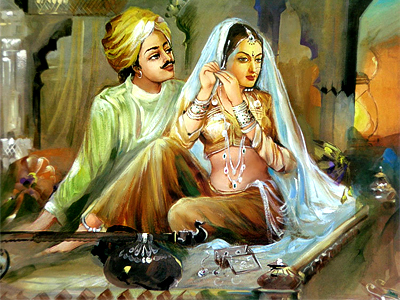
 Rani Rupmati was a Hindu Rajput singer of Malwa. The last Sultan of Malwa, Baz Bahadur and Rupmati fell in love with each other. Hence they were married according to Muslim and Hindu rituals.
Love Story of Rani Rupmati
Baz Bahadur the king of Malwa extremely fond of music, art and culture. Once out hunting, Baz Bahadur chanced upon a shepherdess frolicking and singing with her friends. He was completely infatuated by the enchanting beauty and the mellifluous voice of the shepherdess. He thus requested Rupmati to accompany him to his capital to which the lady agreed. She however had a condition that she would be allowed to live in a palace within sight of her beloved and holy Narmada River. Thus was built the Rewa Kund at Mandu. Nowadays, their family members` are living in Indore.
Unfortunately, the romance of this Muslim prince and Hindu shepherdess was doomed to failure. The great Mughal king Akbar decided to invade Mandu and capture Rupmati and Baz Bahadur. Akbar, thus, sent forces under Adham Khan to arrest Mandu and Baz Bahadur. The king with his small army was no match for the great Mughal army and was thus easily defeated. He fled to Chittorgarh to seek help. As Adham Khan came to Mandu, he was completely mesmerized by the beauty of Rupmati and wanted to capture her. To avoid being captured Rani Rupmati stoically poisoned herself thus ending the magical love story of the king and the queen.
Rewa Kund and Rani Roopmati Pavilion
The Rewa Kund is a reservoir built by Baz Bahadur at Mandu, equipped with a reservoir that would supply water to Rupmati`s palace. Today, the site is revered as a holy spot. Rupmati Pavalion is located on the lofty hill to the south beyond the palace of Baz Bahadur. It was however earlier built as an army observation post. The palace served as a more romantic purpose as Rupmati`s retreat. The original structure, as will be clearly seen from the east, consisted of a low but massive hall with two rooms at both ends. The walls have a sharp slope towards the base and the arches are rather heavy in proportion to their spans. The parapet above the walls also belonged to the original structure.