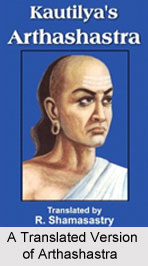
 The Rajamandala was formulated by the Indian author Kautilya in his work on politics, the Arthashastra. The Arthashastra was written between 4th century BC and 2nd century AD. The book is an ancient Indian treatise on statecraft, economic policy and military strategy, written in Sanskrit. The Rajamandala theory is a part of the book which describes the circles of friendly and enemy states surrounding the king`s state. The theory emphasizes on the alliances that a king has to make with friendly states to deal with the enemy state and his friends.
Etymology of Rajamandala
Raja-mandala means "circle of kings". Raja is derived from Sanskrit that means a monarch or princely rulers. The term "mandala" is a Sanskrit word that means "circle".
Terminology of Rajamandala
According to studies, the term draws a comparison with the mandala of the Hindu and Buddhist worldview. The comparison focuses on the radiation of power from each power center and the non-physical basis of the system.
The term was revived 2000 years later and several metaphors were used to describe mandala. It was revived as a consequence of Twentieth Century efforts to comprehend patterns of diffuse but coherent political power. Social anthropologist Tambiah`s idea of a "galactic polity", describe such political patterns as the mandala. Historian Victor Lieberman preferred the metaphor of a "solar polity†to describe the mandala. In the solar system, there is one central body, the sun, and the components or planets of the solar system and it is the same in mandala system. Then British historian O. W. Wolters established that the "Rajamandala" concept of ancient India was the prototype for the Mandala model of South East Asian political systems in later centuries.
This article is a stub. You can enrich by adding more information to it. Send your Write Up to content@indianetzone.com