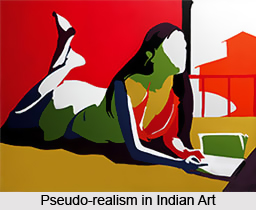
 Pseudo-realism in Indian art implies an innovative style of visual arts which includes paintings as well as films which employ superficial or non-realistic means of elements like offbeat colours, shades or abstract shapes and geometric shapes and symbols, aimed at creating a meaningful imagery, with reference to the entire work of art. Born in India in the 21st century, the genre of pseudo-realism or `pseudo-realism` in arts has been gradually gaining immense popularity not in the country, but also overseas. Also known as `pseudo-real art`, it encompasses the marvellous technique of introducing the feature of surrealism in dramatic styles for presenting an art-form which is quite believable, equipped with strands of reality. Depending solely upon the subject of the painting, the depiction of the subject might or might not be in sync with the general mood of the art-work.
In the year 2006, Devajyoti Ray, a reputed contemporary Indian artist imparted another definition for the art-form of pseudo-realism, who coined this term and is a prominent figure in the field of pseudo-realism in the country. According to him, pseudo-realism refers to the intelligent placing of complex colours and shapes for creating practical images. He is the singular Indian artists who exhibit a keen eagerness and interest in this particular genre of art. Devajyoti Ray is widely appreciated for his pseudo-realism paintings as he employs simple motifs, offbeat hues and geometric patterns to seamless give birth to a completely comprehensible reality. The creations of magic realists also involve the characteristics of pseudo-realism.
Pseodo-realism has gained significance both inside as well as outside the nation and its theme has been implemented in 3D computer graphics, CGI animation and others. Several television programmes, film productions and video utilize this unique art concept to make their presentations even more appealing, using special effects. Similar to the idea of magic realism in the spheres of visual arts, literature and films, pseudo-realism is developing into a major genre of modern arts. Some people are of the view that the concept of pseudo-realism has been derived from Mathematics, particularly the `representation theory`, which refers to the idea which believes that unrealistic can sometimes create the impression of the real.