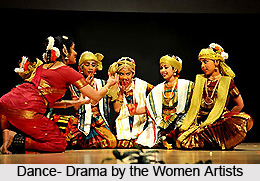
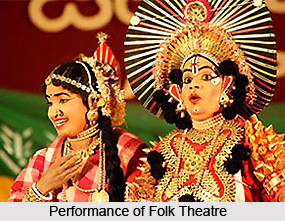
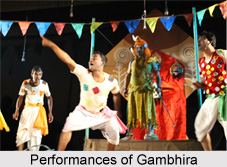
 Performances of Gambhira are absolutely different type as compared with other folk music traditions of North and West Bengal. Plausibly, perhaps, Gambhira could have been discussed as other than folk cult, but it is definitely treated as folk-music. Due to the impact of urbanization a large part of folk-music has been converted into a popular subject or into a form of cultivated music by a class of musicians. But Gambhira has not been touched so much by the fastness of urbanization. Its compositions are mainly concerned with problems of life. Following the track of rural Jatra, Pancali and Kavigan the type of its music has, of course, undergone some changes.
It may be described thus: During the end of the month groups of people take the vow of sanyasin (wearing dress and taking food like an ascetic) and establish ghot (the earthen pot filled with water) as the holy symbol of Siva who is worshipped as the principal deity.
The second day`s function is Chhota Tamasa (smaller amusement) dealing with Parvati`s (the wife of Siva) joining the scene.
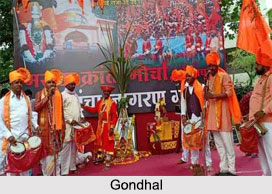
On the third day, Bada Tamasa (the big amusement) begins with procession of bhaktas (devotees) for worship of Hara-Parvati. In it all young and old people take part, they dress peculiarly and dance together. Mask dance of Hanuman is held, because Hanuman was deputed to carry Siva from the Himalayas before the sea was crossed by Rama on his way to Lanka. They dress peculiarly and come to the pandal shouting the name of Siva. Dhak, the big drum, and kansar are familiarly used for accompaniment to dance, then begins the song session. The theme of songs deals with merits and demerits of Lord Shiva. Spectators are amused by the dance. New compositions reporting faults of fellowmen are recited. Besides songs on Siva, songs of lighter vein are also sung. About the day-break, the dance of the crematorium introduces goddess Kali dancing in the Gambhira house and this is followed by other rituals. This part of the performance was very popular in eastern areas, that is, in Bangladesh, half a century ago.
On the fourth day of Gambhira festival the ceremony of feeding Brahmanas takes place. On this day cultivation is also represented in the scene. At night a special session of songs is held when composers present musical recitals narrating various events of the outgoing year. These themes of music deal with contemporary problems of livelihood in the garb of ovation to Lord Shiva the central deity of Gambhira festival. Shiva, who is focused as the presiding deity ruling over the life and work of rural people of all times, is subjected to criticism for his failure to mitigate the sufferings of men in their day-to-day lives. Shiva is told about failure of crops, rise in the price of rice, spread of malaria, poverty, etc. Now, when it is believed that Siva was mixed up with the personality of Sun-god who was the central deity earlier, Siva songs may be found to be less important.
In modern Gambhira songs, political ideas and contemporary events are also included. On the fifth day, i.e., the last day of the month of Chaitra (March-April), Cadak Puja, religious ceremony of swing or whirling, is observed by general Hindus of West Bengal. The entire ceremony bears the stamp of Gajan in different districts. In fact, Gambhira is believed to have been transformed into Gajan of Dinajpur, Murshidabad, Bankura, Birbhum, Burdwan, Hoogli, Nadia, 24 Parganas and so on.