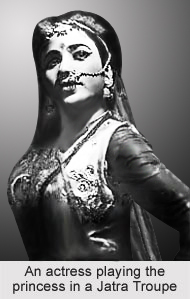
 Music in Jatra has had a profound effect on the art. Indian classical music and folk music come together in Jatra. There is hardly any jatra singer-actor who does not know the classical ragas. Various ragas and classical melodies were accompanied with dance and dialogue in jatra to create the atmosphere. A huge repertoire of semi classical and classical notes and melodies goes in the creation of Jatra. The mood song, prayer song and the songs meant for separation are invariably set in classical notes. The journals of 19th century often commented about the musical quality of performances related to Jatra.
Types of Music in Jatra
Most commonly used ragas in jatra are bhairava, bageshri and bhairavi. For plays having historical relation or themes related to mythology, the classical ragas always evoke the period. Minor less important characters like; gardeners, servants, robbers, monks, use the folk music (Kirtan and Bhatiali songs) to signify their day-to-day existence. The very first concert at the opening of play is always set in accordance with Indian classical music. The second concert is generally light and the orchestral music follows the character and mood.
System of Singing on Behalf
During the middle of 19th century, the process of singing had become more complex in jatra- when the "palas" of Bidya Sundar had degraded into mere erotic dancing and singing. A new jury system was introduced by Madan Master, a professional at Hoogly College. He introduced certain new systems to make the process of music in Jatra easy to be understood by the audiences.
Madan Master realized that some of the actors are not getting used properly due to their inability to sing. Hence in order to provide a chance to dramatic actors he introduced the system of "singing on behalf". He made a rule of four singers sitting at the four corners of stage to sing on behalf of the characters, as their doubles.
The actors in Jatra started the song and then tossed it to one of the squatting singers, who stood up immediately. The line was then taken up by singers sitting on the right or diagonally opposite. One after the other the singer rises in turn as the song progresses. They spun out the melody and also added graces and frills, concerned not so much with the words as with subtle elaboration. This helped the spectators and players to release the burden of understanding the literary words and thinned the melody to fine musical web.
Introduction of Dohar System
Madan Master, apart from the jury system, also introduced the Dohar system. Doha means "the refrain" and the Dohars were people who sang the refrain. Side by side with the jury classicists, a set of singers simply rendered the refrain, thus helping to bring the etherealized melody down to earth and reinforcing it. The refrain gave the Jatra singing a new strength. The Dohar system was inspired by the Kirtan in which the principal singers sing with musical flourishes and the refrain is taken up by the religious gathering, which beat cymbals and wooden clappers and goad the tempo to a delirious climax.
Musical Instruments used in Jatra
The musical instruments that accompanied old Jatra were various forms of drums, pakhawaj, khole, and violin. During the Vedic period, the pinga- a stringed instrument- was played with the help of canonical bow. The name was later, changed to "bahuleen", meaning an instrument played by resting it against the bahu (arm), and from this came "behala" (the Bengali word for violin). Another name of the pinga was ravanstra. Cymbals and flutes were also important parts of jatra.